Forum Discussion


j-d
Aug 23, 2015Explorer II
The "C" in "Class C" stands for Compromise. The house portion wants to be much taller than the cab on that cube van chassis. The house needs headroom. Headroom's easier to get if the house sits right on the chassis. Our first C was that way, flat floor tip to tail. The headroom in the great room was OK, but it made for a very shallow cabover, height-wise. It was also a Five-Foot climb from house floor to cabover bunk. I called that bunk "The Loft" to give it an air of respectability. But mounting right at chassis height doesn't allow much outside storage, so to build a "basement" Class C, the house floor is up on a platform. Ah, but the cab isn't raised along with it, so there's a step up from cockpit to house. Maybe that's OK, but it ruins the view out the windshield of a parked basement Class C. That raises the height of the coach, making a taller cabover area and that's good. The higher floor means less climb to the overhead and that's good. More like Four Feet in a modern, basement, Class C.
For the first C, we first tried a kitchen stepladder, which had to be unfolded and used as a free standing ladder. Not very friendly. We got a five-foot folding aluminum stepladder. The floor was carpeted, and we could lean the closed ladder against the bunk, and it didn't slip on the floor.
My suggestion would be to get a wooden stepladder and customize it to your bunk and floor. You might be able to do away with its back legs entirely, and you can easily staple carpet to the rungs to comfort your feet. Add brackets to the bunk area if you need them to feel secure.
I'm intrigued with Southwest Pueblo/Kiva Ladders which have the side rails extending well above the top rung. A built-in hand rail if you will. Often one rail extends more than the other.
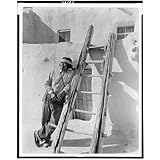
This provides balancing support without the climber having to get between or around the rails. You could add a piece of wooden closet rod to one rail of a wooden ladder and accomplish this. Extend that to the ceiling and your ladder'd become tip-proof. But please, if you do that, find the roof trusses and develop a way to tie the ladder's support point to one/them. RV ceilings aren't very rugged.
For the first C, we first tried a kitchen stepladder, which had to be unfolded and used as a free standing ladder. Not very friendly. We got a five-foot folding aluminum stepladder. The floor was carpeted, and we could lean the closed ladder against the bunk, and it didn't slip on the floor.
My suggestion would be to get a wooden stepladder and customize it to your bunk and floor. You might be able to do away with its back legs entirely, and you can easily staple carpet to the rungs to comfort your feet. Add brackets to the bunk area if you need them to feel secure.
I'm intrigued with Southwest Pueblo/Kiva Ladders which have the side rails extending well above the top rung. A built-in hand rail if you will. Often one rail extends more than the other.
This provides balancing support without the climber having to get between or around the rails. You could add a piece of wooden closet rod to one rail of a wooden ladder and accomplish this. Extend that to the ceiling and your ladder'd become tip-proof. But please, if you do that, find the roof trusses and develop a way to tie the ladder's support point to one/them. RV ceilings aren't very rugged.
About Motorhome Group
38,781 PostsLatest Activity: Aug 23, 2026


