Forum Discussion


ron_dittmer
Jul 02, 2019Explorer III
Under 2500 pounds is a light weight tow vehicle. It will not be stressing any available tow bar. Seemingly, it then boils down to what tow bar is most friendly to use for the particular vehicle you are towing. You do need to make sure your tow vehicle can be towed and the tow bar you select also has an available tow bar bracket specifically designed for your vehicle.
As far as a tow brake is concerned, your available options will get your head spinning. There are pros and cons to each. Some are installed and left in for-good. Others are less intrusive and can be used in various tow vehicles, but can be cumbersome because you remove them before driving the vehicle.
Any tow bar and tow brake setup will require a minimum of
- tow bar
- tow bar bracket (permanently installed on your tow vehicle)
- 2 safety cables (colored light blue in the picture below)
- umbilical cord (for tow brake and tow vehicle lighting, the red coily)
Many setups will also have a thin break-away cable (see picture) which activates the tow brake in the event of a total accidental separation between vehicles while being towed.
Pending vehicle height mismatch, you may require a hitch riser (see picture), then "Quiet Hitch" brackets are recommended (also in the picture)
If the tow brake installation is done cheap and dirty, you could have an additional umbilical cord to support the tow brake independent of lighting.
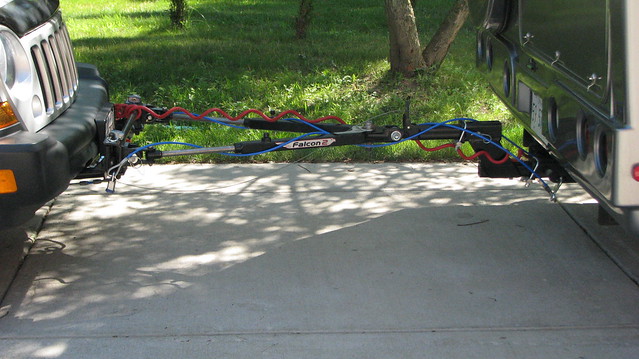
The above picture is our setup, a 4300 pound 2006 Jeep Liberty towed by a 2007 E350 chassis, a Phoenix Cruiser 2350 motor home with a 5000 pound hitch. I installed a UNIFIED TOW BRAKE, a system that is installed and left inside our Liberty all the time.
Our previous tow vehicle was a 2000 Toyota MR2 Spyder that weighed 2100 pounds. We got by without a tow braking system which to be honest with you, was marginal. Surprisingly, that light weight vehicle pushed hard when braking the motor home.

As far as a tow brake is concerned, your available options will get your head spinning. There are pros and cons to each. Some are installed and left in for-good. Others are less intrusive and can be used in various tow vehicles, but can be cumbersome because you remove them before driving the vehicle.
Any tow bar and tow brake setup will require a minimum of
- tow bar
- tow bar bracket (permanently installed on your tow vehicle)
- 2 safety cables (colored light blue in the picture below)
- umbilical cord (for tow brake and tow vehicle lighting, the red coily)
Many setups will also have a thin break-away cable (see picture) which activates the tow brake in the event of a total accidental separation between vehicles while being towed.
Pending vehicle height mismatch, you may require a hitch riser (see picture), then "Quiet Hitch" brackets are recommended (also in the picture)
If the tow brake installation is done cheap and dirty, you could have an additional umbilical cord to support the tow brake independent of lighting.
The above picture is our setup, a 4300 pound 2006 Jeep Liberty towed by a 2007 E350 chassis, a Phoenix Cruiser 2350 motor home with a 5000 pound hitch. I installed a UNIFIED TOW BRAKE, a system that is installed and left inside our Liberty all the time.
Our previous tow vehicle was a 2000 Toyota MR2 Spyder that weighed 2100 pounds. We got by without a tow braking system which to be honest with you, was marginal. Surprisingly, that light weight vehicle pushed hard when braking the motor home.
About Motorhome Group
38,763 PostsLatest Activity: Dec 05, 2025


