Forum Discussion


JBarca
Dec 25, 2012Nomad II
Hi Dragr1,
Does your 3500 truck have a 2 1/2" receiver?
What you are looking at doing is similar to mine. I looked up your camper, http://www.jayco.com/products/travel-trailers/eagle-/floorplans-specs
Nice camper. That 1,075# TW is the empty TW. Looking at the floor plan when you are loaded it can approach 1,400, maybe higher.
In my case my F350 only came with a 1,250# WD rated receiver on the truck. I needed more TW capacity so I upgraded it to the Reese Tow Beast (now called Titan) which is a 2 1/2" receiver rated at 1,700# in WD mode. It is a very good receiver. Curt also makes a good 2 1/2" receiver. The newer truck have been coming with higher rated receivers. You will need to check what your rating is.
This allowed me to use the Reese 2 1/2" shank that then tapers down to 2" to fit the HP trunnion bar hitch head. This shank is rated at 1,700#. In my case I have 1,700# WD bars. They did not offer the 1,500# WD bars back then, they do now. And when I put the bikes on my A frame carrier, I'm at a 1,600# TW so I need them. In your case the 1,500# bars may work or the 1,700#. If you will end up with much weight in the back of the truck aft of the rear axle, then I would suggest the 1,700# bars and move on with it.
Get the 1,700# Reese HP Trunnion bar WD hitch with the Reese DC. On that 37 ft TT you need a good WD hitch with proper TW and Balance (I would go toward 15%) and a good anti sway.
The back of your truck is going to squat, 1 ton truck or not, it will squat. On my Ford, between bed weight and loaded TW the overload (helper) springs just kiss the frame brackets. This is a good thing as it creates better left to right stability, sort of like a sway bar on the back of the truck.
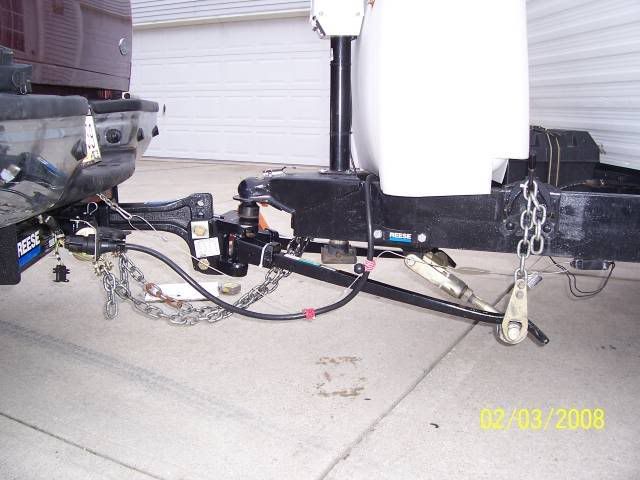
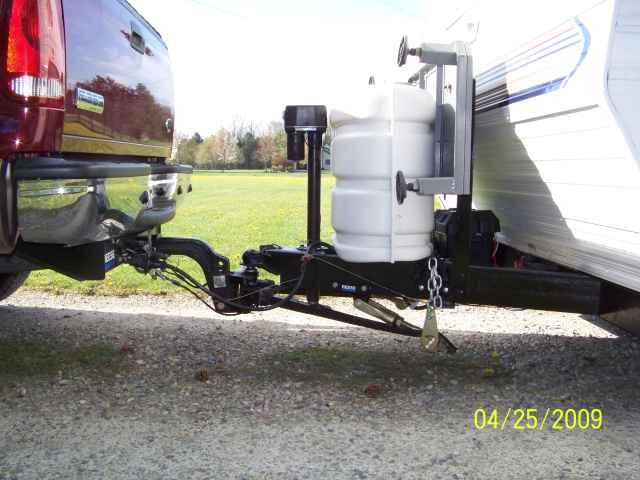
Drop shanks, Jayco uses the bottom mounted tow ball coupler I believe on your camper. Once you sort out the truck receiver you need to figure out which of 2 Reese shanks will work. I happen to have both for various trailers I use.
Here is the standard shank in the drop configuration on my current TT.
Here is the large drop shank on my older smaller camper.
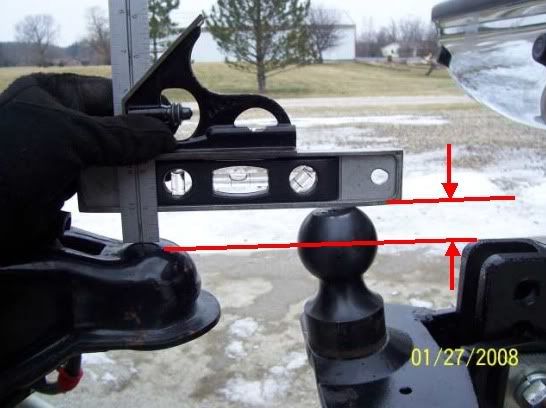
Before you can figure out which shank you need, you need to know the ball height on the camper when level. Ball height is, TT level, and the distance from the ground to the inside ball part of the coupler.
Next you need the truck dimensions on the actual receiver you are going to use. Need to put weight in truck bed, then distance from ground to top of pin box or top of shank at the pin box. Then add approx 1.5" more for rear truck squat. The shank and hitch head with tow ball then create the ball height at the truck. It will look like this before hitching once you sort this out.
A friendly heads up, learn this WD hitch how to mount it and how to adjust it. Many (not all) dealers do not do a good setup of it or drill the DC on correctly. And even if they did mount it correct, the trailer is empty when you bought it. It will need adjusting after you load it.
As an option, if you have to buy a new receiver there is another WD hitch that is by far superior to the Reese and will handle that heavy 37 foot camper. Look up Pullrite hitch http://www.pullrite.com/pullrite_90.htm Hands down there will be no sway. It solves the receiver problem and creates the WD hitch and no sway as part of the hitch operational concept. The only down side is using it as a weight carrying hitch on trailers that do not need WD. For my truck this would limit it to 350# TW and I tow several trailers with no WD. As far as WD it can deliver 2,000#. Cost wise, a new TV receiver and new Reese Straightline WD hitch will be over $1,000. The Pull-rite is over $2,000 but less than $3,000. In my case if the Reese would not create a stable towing TT, the Pullrite was next.
Hope this helps and good luck.
John
Does your 3500 truck have a 2 1/2" receiver?
What you are looking at doing is similar to mine. I looked up your camper, http://www.jayco.com/products/travel-trailers/eagle-/floorplans-specs
Nice camper. That 1,075# TW is the empty TW. Looking at the floor plan when you are loaded it can approach 1,400, maybe higher.
In my case my F350 only came with a 1,250# WD rated receiver on the truck. I needed more TW capacity so I upgraded it to the Reese Tow Beast (now called Titan) which is a 2 1/2" receiver rated at 1,700# in WD mode. It is a very good receiver. Curt also makes a good 2 1/2" receiver. The newer truck have been coming with higher rated receivers. You will need to check what your rating is.
This allowed me to use the Reese 2 1/2" shank that then tapers down to 2" to fit the HP trunnion bar hitch head. This shank is rated at 1,700#. In my case I have 1,700# WD bars. They did not offer the 1,500# WD bars back then, they do now. And when I put the bikes on my A frame carrier, I'm at a 1,600# TW so I need them. In your case the 1,500# bars may work or the 1,700#. If you will end up with much weight in the back of the truck aft of the rear axle, then I would suggest the 1,700# bars and move on with it.
Get the 1,700# Reese HP Trunnion bar WD hitch with the Reese DC. On that 37 ft TT you need a good WD hitch with proper TW and Balance (I would go toward 15%) and a good anti sway.
The back of your truck is going to squat, 1 ton truck or not, it will squat. On my Ford, between bed weight and loaded TW the overload (helper) springs just kiss the frame brackets. This is a good thing as it creates better left to right stability, sort of like a sway bar on the back of the truck.
Drop shanks, Jayco uses the bottom mounted tow ball coupler I believe on your camper. Once you sort out the truck receiver you need to figure out which of 2 Reese shanks will work. I happen to have both for various trailers I use.
Here is the standard shank in the drop configuration on my current TT.
Here is the large drop shank on my older smaller camper.
Before you can figure out which shank you need, you need to know the ball height on the camper when level. Ball height is, TT level, and the distance from the ground to the inside ball part of the coupler.
Next you need the truck dimensions on the actual receiver you are going to use. Need to put weight in truck bed, then distance from ground to top of pin box or top of shank at the pin box. Then add approx 1.5" more for rear truck squat. The shank and hitch head with tow ball then create the ball height at the truck. It will look like this before hitching once you sort this out.
A friendly heads up, learn this WD hitch how to mount it and how to adjust it. Many (not all) dealers do not do a good setup of it or drill the DC on correctly. And even if they did mount it correct, the trailer is empty when you bought it. It will need adjusting after you load it.
As an option, if you have to buy a new receiver there is another WD hitch that is by far superior to the Reese and will handle that heavy 37 foot camper. Look up Pullrite hitch http://www.pullrite.com/pullrite_90.htm Hands down there will be no sway. It solves the receiver problem and creates the WD hitch and no sway as part of the hitch operational concept. The only down side is using it as a weight carrying hitch on trailers that do not need WD. For my truck this would limit it to 350# TW and I tow several trailers with no WD. As far as WD it can deliver 2,000#. Cost wise, a new TV receiver and new Reese Straightline WD hitch will be over $1,000. The Pull-rite is over $2,000 but less than $3,000. In my case if the Reese would not create a stable towing TT, the Pullrite was next.
Hope this helps and good luck.
John
About RV Tips & Tricks
Looking for advice before your next adventure? Look no further.25,186 PostsLatest Activity: Mar 12, 2026


