Forum Discussion

eastover's avatar
eastover
Explorer
Feb 13, 2015

Converter question

Somehow I got 240 vac to my camper. The breaker tripped on the 120 side but I wonder if my converter is cooked. I don't have a battery but the voltage problem was rectified on the shore power issue. All the 120 appliances work fine but I don't have 12 volt power for lights. Suggestions?

9 Replies

  • I replaced mine with a powermax boondocker and it is great. Call Randy @ Best Converters.
  • wa8yxm's avatar
    wa8yxm
    Explorer III
    Padlin wrote:
    Just for my knowledge, are the 120 and 240 connectors that much alike that they can forced together? or is it more of someone wiring 240 to a 120 receptacle?


    The common TT-30 is labeled 125 volts max, however it looks a lot like a 240 volt outlet and though there is no 240 volt outlet that is identical.... Well,, ,it often gets either 1: Wired for 240 volts or 2: Used "off label" for 240 volt devices.

    So yes there is.

    To the original poster, There are 3 posibilities

    1: Fuse or breaker on the 120 volt side (may have both) tripped or blown
    2: Fuse on 12 volt side,, (it will have 1 or 2) blown
    3: Toast

    If Toast then consider the following
    Stand alone converters,, progressive Dynamics 9200 line (match the last two digits with what you have now)

    Intergrated (power distribution panel and converter in one) Progressive Dynamics 4600 series (Same advice on last two digits)

    NOTE last 2 need not be an exact match, ie a 35 can be replaced by a 40.
  • DrewE's avatar
    DrewE
    Explorer III
    Breakers (at least the traditional kind) respond only to current, not to voltage. If you don't have any other 120V appliances that are damaged, you are quite fortunate indeed. Many smaller electronic devices these days will work fine on either 120 or 240 volts (or most anything in between), but larger appliances like microwaves and air conditioners and so forth are usually voltage sensitive.

    The converter charges the battery when on shore power.

    It's unlikely that there's a fuse between the converter and the 120V distribution panel. It's fairly common for it to be on its own breaker, so checking that all the breakers are not popped is a good idea. Some breaker designs will look like they're on when they've popped.

    There may be an internal fuse on the converter itself. If there is and it's blown, the converter may still be blown. The purpose of any fuse like that is primarily to prevent a fire and only secondarily to prevent damage to the converter.

    Testing the converter is pretty simple. If you put 120VAC in and you get nominal 12VDC out, it's working. If you get something else out, like 0V or 15V or 23V, it's not working. If there are sparks flames, it's definitely not working!

    If you do need to replace the converter, I'd suggest thinking about an upgrade. The Progressive Dynamics 9200 series consistently gets very high praise here, though there are others that are also well regarded.
  • The guy wired 240 to the outlet. Thankfully the main breaker tripped, saving all of the 120 appliances. I'm afraid however that the converter is toast. How can I test it? Does it also charge the battery when on shore power? Is it possible that there is a fuse between the converter and the shore power source?
  • RoyB's avatar
    RoyB
    Explorer II
    I am assuming you are aware that DOT requires a RV trailer equipped with electric brakes that uses PUBLIC ROADWAYs to have an on-board battery system to operate your electric brakes in the event the RV trailer becomes disconnected going down public roadways.

    This could affect your INSURANCE CLAIMs big time if known you do not have a working battery system.

    Good luck with finding all of the 120VAC appliances and sensors that are normally always ON. The 240VAC usually blows all of them. This includes MICROWAVEs, Fridges, Converter/Chargers, TV sets, Clocks, etc...

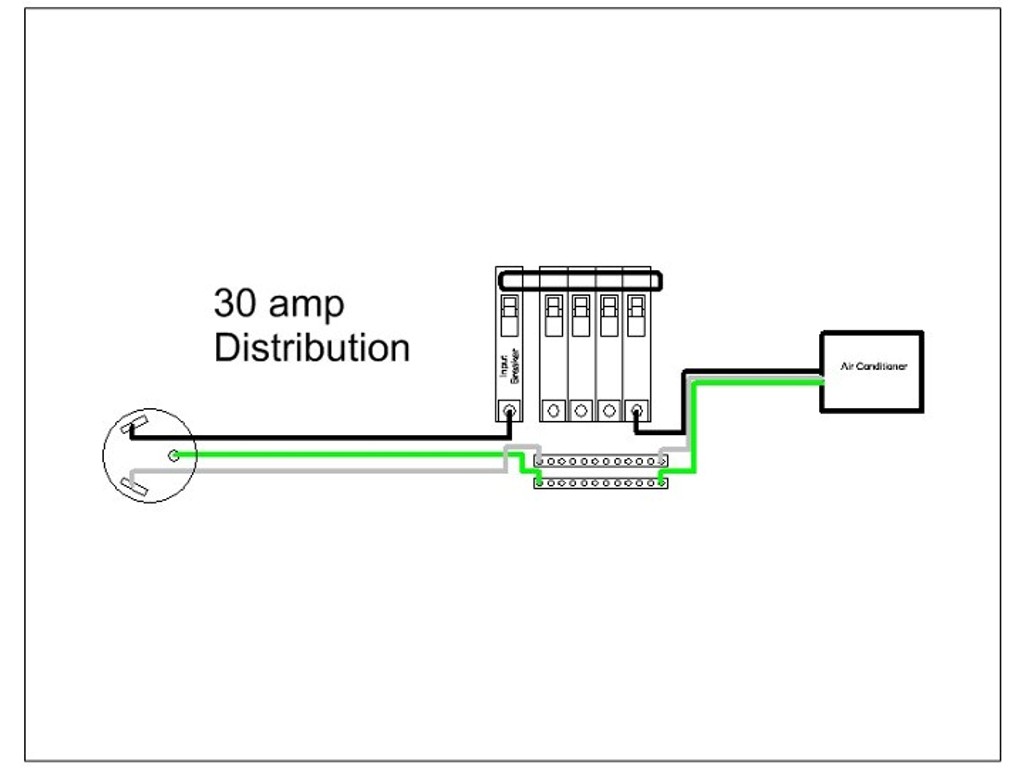
    This is typical 30AMP Electrical Wiring Configuration Block Diagram that might give you some help on what might be connected to the 120VAC side of the Power Distribution Panel.


    These just don't somehow happen...
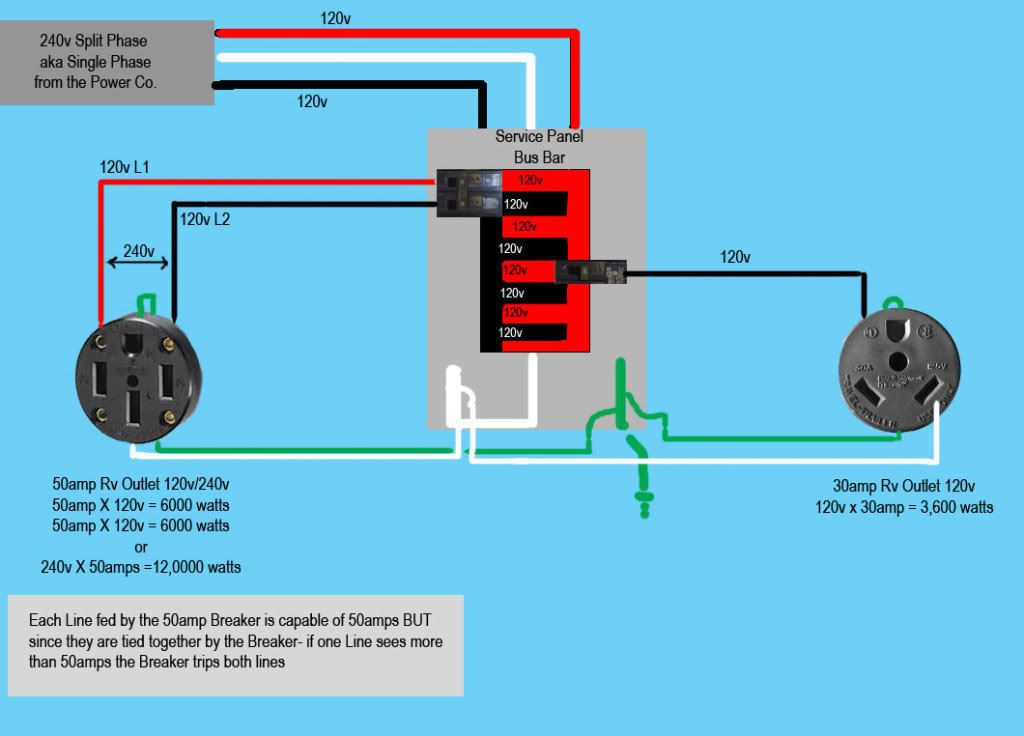
    Always check the wiring at the 50A and 30A receptacles before plugging your trailer into them.

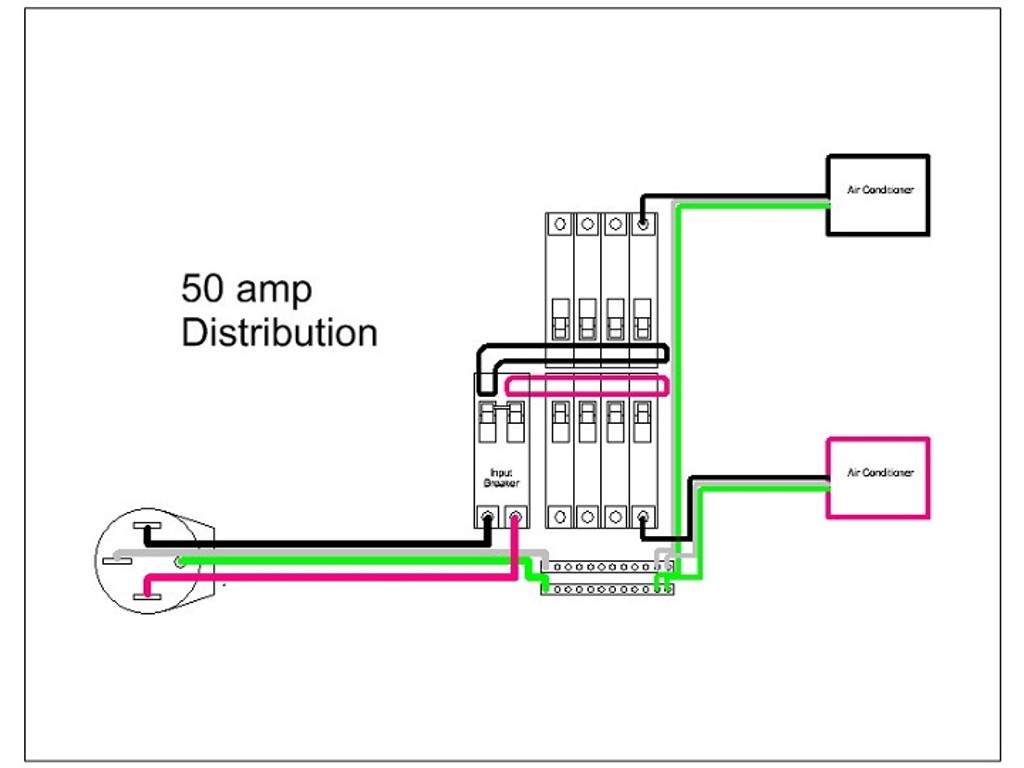
    50A RV Receptacle - NOTE you have 240VAC available between the two HOT WIREs but these are only used in high-end RV UNITS mainly for DRYERS etc. Most 50A RV trailers only use two zones of 120VAC


    TYPICAL 50A 120VAC Distribution

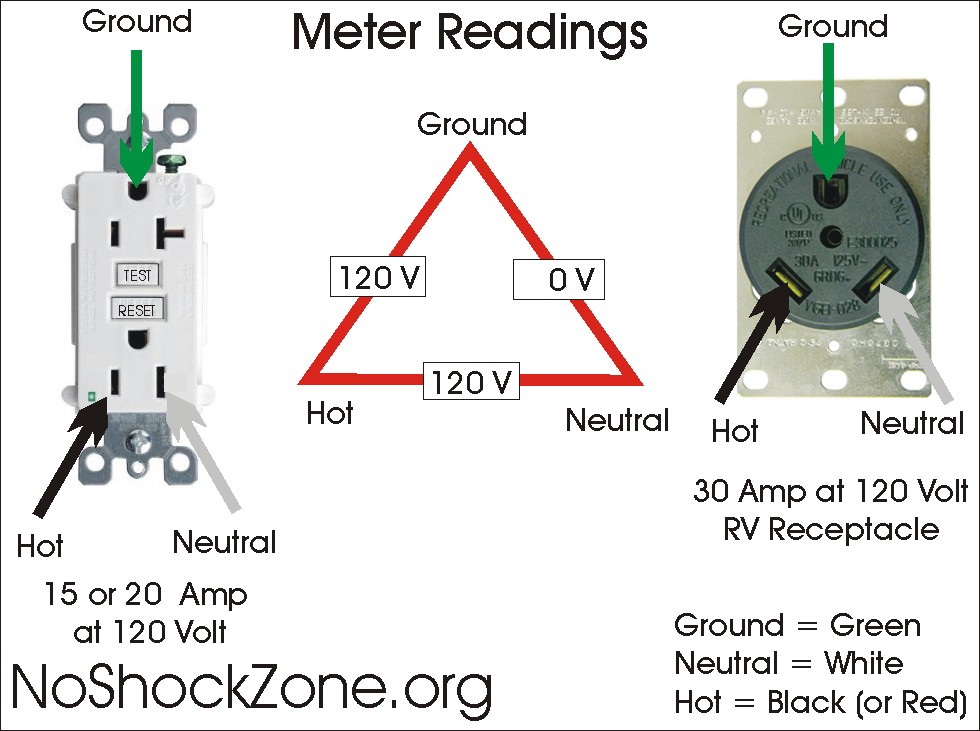
    30A/20A/15A Receptacles

    TYPICAL 30A 120VAC Distribution

    Typical campground PEDESTAL WIRING diagram

    Always use BONDED Electricians when doing 120VAC wiring for RV units. Bonded means the ELECTRICIANS have INSURANCE to replace all of the 120VAC APPLIANCES that get blowed up when they get misswired.

    This could cost you a few thousand dollars before all said and done..

    Good luck...

    Roy Ken
  • Just for my knowledge, are the 120 and 240 connectors that much alike that they can forced together? or is it more of someone wiring 240 to a 120 receptacle?
  • Probably looking at replacement. What do you have now? What do you need?
  • DrewE's avatar
    DrewE
    Explorer III
    Clearly your converter isn't doing anything at the moment, or a fuse blew between it and your 12V distribution panel. It should be pretty straightforward to troubleshoot with a voltmeter: do you have 120VAC at the converter input? Is there 12VDC at its output terminals? Does it have any fuses on it that are blown?

    My guess is that you'll need a new converter. It's possible too if it put out a high voltage spike in the 12V system that some 12V appliances are also damaged...but you can't really check that until you have a working converter or a charged 12V battery hooked up.

About Technical Issues

Having RV issues? Connect with others who have been in your shoes.24,370 PostsLatest Activity: Mar 16, 2026
