Forum Discussion


NinerBikes
Apr 23, 2015Explorer
Waaaaaaaay too much work and babysitting, for the amount of electricity they provided you on a 4 or 5 day camping trip.
You've spent 2 weeks monkeying with these, for what, one week of camping?
I zapped my Trojan T-1275 for 1 hour and 40 minutes at 15.0V... Amperage started at 28 amp take rate from my 30 amp Mega Watt Power Supply Unit that was $50, that mexicowanderer suggested. Amperage charge rate was down to 7.8 to 7.9 Amps when I shut the little Honda Eu1000i off.
Today, I will go back, put the 150W 8.5 a/h capable poly solar panel on it once the sun is shining, and set the charge controller for 16.0V. 2 or 3 hours of sunshine should pop that Trojan T-1275 right back where it belongs, if history repeats itself. The solar panel is balanced to the battery size, right where mexicowanderer said it should be for equalize charging, a C/20 charge rate.
Battery was made in August 2011 and served well in a golf cart for about 20 months before being deemed unsuitable for a golf cart, when I got my hands on it. I can usually run 2 days on it trailering without worry about V dropping to or below 12.0V. I like to try to keep it above 12.1V at rest, at all times.
Battery chemistry limits the amperage charge rate take, every time. Can't take much amps if there's no sulfur to be sucked out of the nooks and crannies all over all those thick plates. Thick plates = less plates = less surface area = slower going for top charging IF the battery shape is not ideal or large enough electrolyte capacity to lead plate capacity.
Real battery jars are tall for good reason... it's called ratio right, enough electrolyte volume to lead plate volume. And good design, not hampered by retarded car hood parameters.
The devil is always in the details... minute little details that EE's and battery people know, on how to get a complete balanced system, battery amp hour capacity wise, to charging capacity, be it bulk, absorption, or equalize charging. There is a proper size and charge rate for everything, when engineered properly.
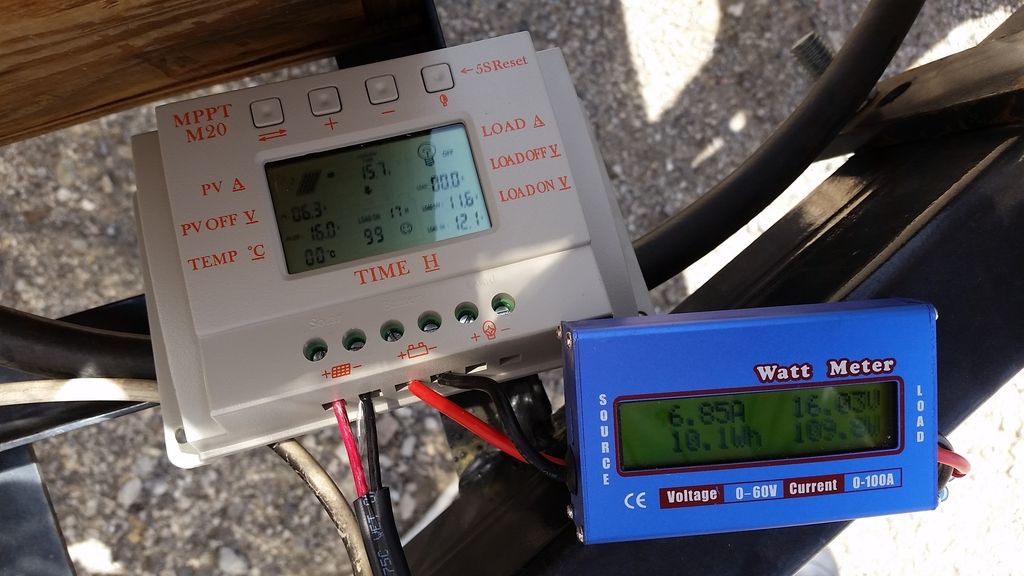
Here was the last equalization in progress. Note the watt meter says 16.03V being provided. If you look at the MPPT20, in the upper center of the display it indicates 15.7V. That has been confirmed by me numerous times as being the voltage at the battery terminals by a hand held Digital Multi Meter. So, that is the number I need to pay attention to getting up to 16.0V for a complete equalization charge to be completed.
You've spent 2 weeks monkeying with these, for what, one week of camping?
I zapped my Trojan T-1275 for 1 hour and 40 minutes at 15.0V... Amperage started at 28 amp take rate from my 30 amp Mega Watt Power Supply Unit that was $50, that mexicowanderer suggested. Amperage charge rate was down to 7.8 to 7.9 Amps when I shut the little Honda Eu1000i off.
Today, I will go back, put the 150W 8.5 a/h capable poly solar panel on it once the sun is shining, and set the charge controller for 16.0V. 2 or 3 hours of sunshine should pop that Trojan T-1275 right back where it belongs, if history repeats itself. The solar panel is balanced to the battery size, right where mexicowanderer said it should be for equalize charging, a C/20 charge rate.
Battery was made in August 2011 and served well in a golf cart for about 20 months before being deemed unsuitable for a golf cart, when I got my hands on it. I can usually run 2 days on it trailering without worry about V dropping to or below 12.0V. I like to try to keep it above 12.1V at rest, at all times.
Battery chemistry limits the amperage charge rate take, every time. Can't take much amps if there's no sulfur to be sucked out of the nooks and crannies all over all those thick plates. Thick plates = less plates = less surface area = slower going for top charging IF the battery shape is not ideal or large enough electrolyte capacity to lead plate capacity.
Real battery jars are tall for good reason... it's called ratio right, enough electrolyte volume to lead plate volume. And good design, not hampered by retarded car hood parameters.
The devil is always in the details... minute little details that EE's and battery people know, on how to get a complete balanced system, battery amp hour capacity wise, to charging capacity, be it bulk, absorption, or equalize charging. There is a proper size and charge rate for everything, when engineered properly.
Here was the last equalization in progress. Note the watt meter says 16.03V being provided. If you look at the MPPT20, in the upper center of the display it indicates 15.7V. That has been confirmed by me numerous times as being the voltage at the battery terminals by a hand held Digital Multi Meter. So, that is the number I need to pay attention to getting up to 16.0V for a complete equalization charge to be completed.
About Technical Issues
Having RV issues? Connect with others who have been in your shoes.24,373 PostsLatest Activity: Apr 02, 2026


