mena661 wrote:
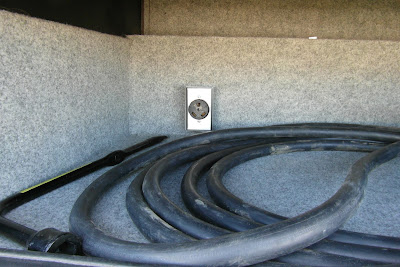
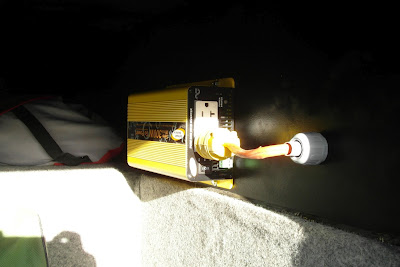
Who said anyone runs their inverter 24/7? Anyways, I run mine whole house. I have a 30A RV receptacle in my shore cord compartment. The receptacle is wired to my 300W inverter. I plug the MH's shore cord into the 30A. I turn off the converter. When my inverter overloads, it just shuts off. I simply turn it back on.
30A RV Receptacle
Inverter with 20A plug wired to 30A RV Receptacle on other end
Mena, nothing wrong with doing what you did, just merely pointing the flaws in this setup.
Nothing is intuitive nor automatic, gives lots of chance of doing something wrong, not everyone will remember to do things in proper order each and every time.
Not to mention getting all the family members to remember to turn the inverter OFF when no longer needed, hence the comment of leaving it on 24/7 which WILL happen.
Basically if you have family members, each and every one would have to be fully trained in all aspects of such a setup so kids and adults would have to have a good understanding what breakers that can be left on or must be turned off. It is hard enough to train kids (and some adults) to remember to turn off lights that are not needed.
Sometimes for everyone involved it is better to make the setup fully idiot proof and automatic, yes it costs more to do it that way but in the end better for all involved.
Myself, I would have no problem plugging in an inverter but I would rather make my setup as simple as possible so the rest of my family does not need a full day of instruction on how to operate the electrical system.
1) In the end it is hard to beat a inverter with ATS for simplicity. (most expensive)
2) Next is an inverter with the addition of a couple dedicated outlets which have no connection the the RV system. (less expensive)
3)Then plugging inverter into the shore cord. (least expensive but requires much more careful attention to loads, converter and such).
Mena, as far as not damaging your inverter, many inverters simply will not "recover" from certain types of overloads.
One main one that sticks in my mind is MANY cheap inverters use a "floating" neutral. These inverters can be easily damaged if for any reason the "neutral" line is accidentally shorted to the BATTERY NEGATIVE (which is also the same as the green safety ground on the inverter). So CARE must be taken to avoid this situation.
Many of the cheap inverters specifically STATE in the manuals to NOT connect the inverter to a power distrubution system. They are not designed for that purpose. So unless your inverter HAS an electrical access box which allows for hardwire connections it most likely is not designed for the usage in your setup.
So, if the OP wishes to do like you did, that is fine by me, but YMMV (Your Mileage May Vary) when taking free electrical advice over the Internet..


