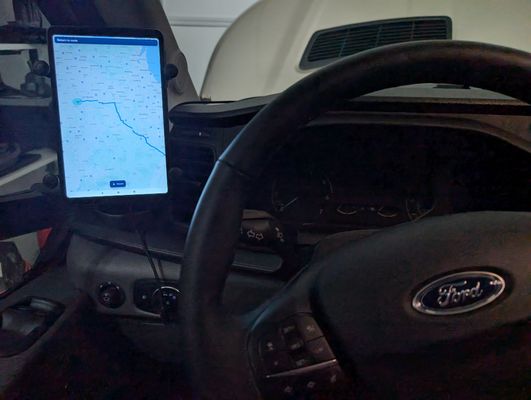
Android 8" tablet for navigation


Everyone has different experiences. I'm not a fan of Waze. I've run it alongside other apps, mainly TomTom, for thousands of miles and have never been impressed by their crowd sourced traffic except in the largest cities. I realize the user base of Waze is sharply divided on that issue.
The main reason that I use an RV specific navigation app is because Google Maps doesn't have a filter to avoid unpaved roads. Most RV nav apps do. On major traffic days, this dirt farm path is Google Maps' suggested route home from work to avoid traffic. I don't want to find myself backtracking from a similar issue in any RV. This is a mere 10 minutes outside of a metro area with 750,000 people.
This is a problematic road/bridge within 100 miles of my home. If you're unfamiliar with it, by the time you can see the bridge height sign at the far east end of the road, to actually be able to read it, you've made the turn already. Now you get to back up a city block on a divided road and into a 4 lane divided highway, to go a different route.
Lastly, I've been detoured around traffic in Atlanta and Nashville more times than I can count. This neighborhood in Atlanta is particularly problematic if it's on the quickest route around traffic.
Do I think I'm going to make a mistake and have an accident or be stranded on a dirt path because I blindly followed my GPS? No.
But when we often travel 8 or 9 hours in a day to get where we're wanting to go, I also don't have time to deal with figuring out a manual reroute because Google Maps routed me somewhere I shouldn't be.

actualy you can avoid dirt roads in waze and you can always change it from fastest route to shortest route if you don't want it to recalculate. My concern is hight of overpasses and such. its not to much of an issue ion Canada but from what I read there are lots of low ones in the US, unless its just people making it sound worse than it is.

People and You Tube make it sound worse than it is. In my lifetime I have only ever seen a small handful of bridges too low for a semi, much less an RV. Codes are codes, and unless it's historical or there's just no reason for a commercial truck to enter that road, it's really not an issue.
That's for sure! Everything is exaggerated online. This topic, especially in one famous Facebook RV forum, can be like a cult. Both the cult of Google Maps and the cult of Garmin are both present in that forum. It's crazy!

Agreed. While rare low bridges exist they are almost always on roads that are obvious you shouldn't be taking the rv down.
Even when they do exist, they sign the heck out of them, so you should have no prob avoiding them.
That's true until it's not true. At this intersection, what is obvious that tells you shouldn't turn left at this intersection?
But when you do turn left, and after there is no great place to turn around, you discover this:
Granted, I cannot cite 5 more examples like this in my 17 years of RVing.
There is no right or wrong here. There's no award for proving that Google Maps is sufficient or that an RV-specific navigation tool is required. Everyone should use the tool that they want to use.



