Forum Discussion


ShinerBock
Jun 07, 2021Explorer
Bionic Man wrote:ShinerBock wrote:Bionic Man wrote:ShinerBock wrote:
I had a work truck 5.0L and later a work truck Ecoboost and they both got the same crappy fuel mileage towing the same exact same trailer. My personal F150 got no different fuel economy than a good friend mine 5.7L Hemi towing roughly the same load (Jeep and gear) down the same roads from Texas to Utah. The only difference was that his engine was huffing and puffing a little more the higher we went while I hardly felt any difference in power.
In my experience, turbocharged gassers get the same horrible fuel mileage when towing as a larger displacement engine with comparable power. More air equals more fuel and a turbocharger increases the amount of air being pushed through the engine just like increasing an engine's displacement does. The only difference is that you can go back to a smaller displacement when you don't need all that air(boost) in a turbocharged vehicle, but can't with a N/A engine of a larger displacment unless it has cylinder dectivatiuon.
I’ll just tell you point blank that hasn’t been my experience. While towing my wake boat, my EcoBoost Expedition gets at least 20% worse MPG than the Yukon 6.2 it replaced. It’s considerably worse when you compare it towing my 17’ fishing boat. Just about everyone on the boating forums I frequent say the same thing.
I’ll also say that the towing experience as well as speed over the passes is better in the EcoBoost than the 6.2. It holds speeds up the passes that the 6.2 simply couldn’t do.
I’m pretty comfortable saying a EcoBoost type engine gets slightly better MPG when solo and quite a bit worse MPG when towing. Which overall is a win in a vehicle that doesn’t tow frequently. But that isn’t what a 7.3 is designed for. It’s designed to be a work truck and if Ford added turbos it would suck fuel like a drunken sailor. The loaded MPG in a vehicle that is designed to spend a lot of time loaded would just make it highly impractical.
And FWIW, for my use in a full size SUV, I’d choose the EcoBoost over a 5.7 or 6.2. Just no way I’d consider it (or especially a super sized version of it) for a full time towing vehicle.
When Pickuptucks.com tested the Ecoboost versus the GM 6.2L, 5.7L Hemi, and Nissan 5.6L back in 2018, the Ecoboost got the best towing mileage and unloaded mileage. However, the 6.2L did get better fuel economy than the other two 5.xL engines when towing. I have read multiple reviews ad MPG loops the 6.2L even got better fuel economy than the smaller 5.3L when towing as well. I am not sure if it is the premium fuel requirement, but many tests I have seen showed the 3.5L Ecoboost and GM 6.2L neck and neck with each other on fuel economy when towing and both are generally better than the rest of the engines.
2018 Best Half-Ton Truck Challenge
I guess I didn’t dig deep enough in the article, but under test results, they call out the EcoBoost for its poor towing MPG.
And, off subject, but I believe at this point both the 6.2 and 3.5 have the same RECOMMENDATION for premium fuel for best performance (not requirement).
Anyway, if the 3.5 is at best equivalent to engines twice its size in towing MPG (I’m still sticking with its worse) than what would a EcoBoost 7.3 be equivalent to? Sounds like it would be the equivalent of a 16 liter engine which MPG would be unimaginably bad.

Regardless if they call it out for unexpected lower fuel economy, it still got better fuel economy towing than the rest.
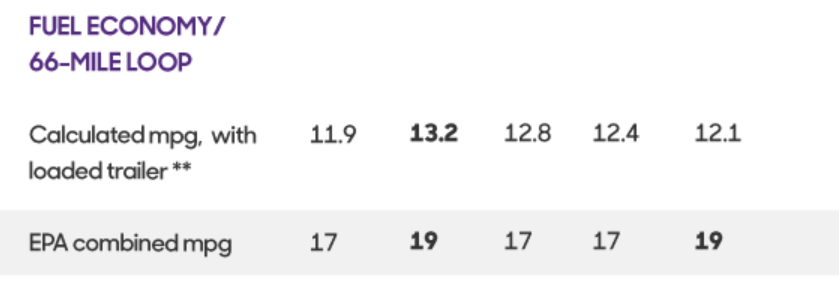
However, you will use more fuel economy than the others if you are using more air to make power. If your old 6.2L was not able to keep speed while your Ecoboost is, then you are likely moving more air in the Ecoboost than you were in the 6.2L meaning you are using more performance than the 6.2L was capable of and therefore using more fuel. If you are utilizing more power from engine A versus engine B, then it is kind of a no-brainer that you will get worse fuel economy in engine A.
Also, there is a huge difference in the premium recommendation between the two. The 6.2L is tuned for premium and its advertised power numbers are based on premium fuel which it clearly states on its SAE certification. If you put regular fuel in it, then you get less power than advertised and have a higher chance of knock due to its much higher compression ratio.
The Ecoboost on the other hand is tuned for regular fuel, but can adjust timing to take advantage of premium fuel to make more than advertised power. For example, my old F150 Ecoboost made 365 hp on regular and 385 hp on premium according to Ford. It doesn't need it, but it is recommended if you want more power out of your engine which is generally when you are towing.
About Travel Trailer Group
44,070 PostsLatest Activity: Aug 07, 2020


