MTBob
May 30, 2013Explorer
Lifting My Rear End - Rev 2
This post is a continuation of my earlier post relating to inserting spacer blocks between my upper spring pack and lower overload spring.
see: http://www.rv.net/forum/index.cfm/fuseaction/thread/tid/26944326/srt/pa/pging/1/page/1.cfm
As a follow-up to my earlier posting, I traveled about 800 miles with the initial 1/2" puck inserts as shown in the previous post. And, just like someone mentioned, YUP, because I didn't have them bolted onto the overload spring, I lost one. I was going over some extremely rough roads east of Glacier Park, MT - really, really rough frost heaves and broken surfaces.
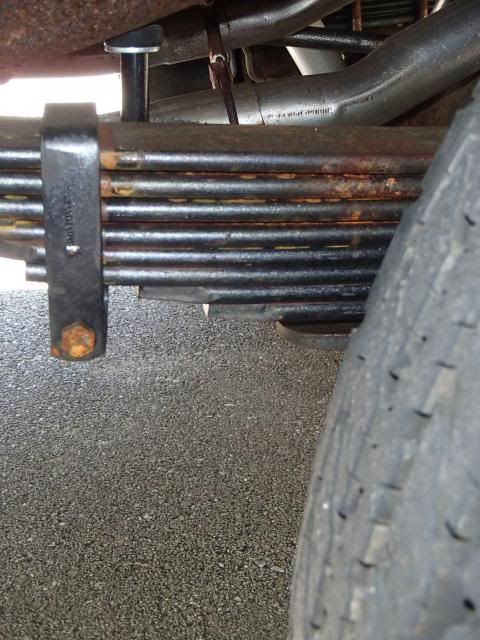
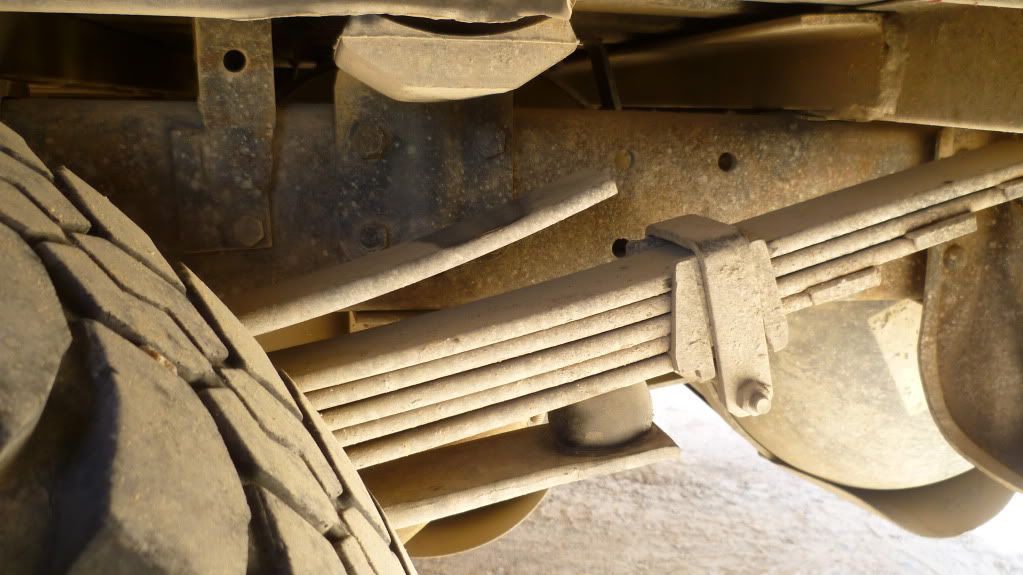
So, when I returned I replaced all the bolts with stainless and drilled & tapped them for a 5/16 securing bolt. I applied medium grade loctite to the 5/16" bolt as a shake proof restraint. I also added an additional 3/8" plastic insert to the puck, giving it 7/8" overall puck height. This is about the same spacing when the camper is not mounted on the truck.
Here's how the puck set up looks now:

After talking to an suspension shop and an alignment shop, they both pointed out another problem resulting from my previously sagging rear end. The front tires have abnormal wear on the outside edge, indicating the camber is improperly adjusted. This is apparently caused by the truck not being level, after only 20,000 miles.

To determine if the truck is level, I'm now measuring the height of the wheel well to the ground, front and rear. With these 7/8" insert pucks the truck is within a 1/4" of level, with about 15 psi +/- in the air bags. That puts the truck suspension strongly in the overload spring and it has raised the rear end significantly. Unfortunately, I don't have a before & after measurement of how much lift I got with the puck inserts. But, I do know that the truck rear end is about 4 - 6" higher.
So, I'll run the rig set up like this for a while and see how it works.
By the way, the High Density Polyethylene (HDPE) plastic seems to be holding up very well. However, Interstate Plastic in Boise recommends Ulta High Molecular Weight (UHMW) plastic for this application. They say the HDPE can crack at temperatures below freezing and that UHMW is a tougher material. If I see problems with the HDPE pucks I'll change over to UHMW material.
Bob
see: http://www.rv.net/forum/index.cfm/fuseaction/thread/tid/26944326/srt/pa/pging/1/page/1.cfm
As a follow-up to my earlier posting, I traveled about 800 miles with the initial 1/2" puck inserts as shown in the previous post. And, just like someone mentioned, YUP, because I didn't have them bolted onto the overload spring, I lost one. I was going over some extremely rough roads east of Glacier Park, MT - really, really rough frost heaves and broken surfaces.
So, when I returned I replaced all the bolts with stainless and drilled & tapped them for a 5/16 securing bolt. I applied medium grade loctite to the 5/16" bolt as a shake proof restraint. I also added an additional 3/8" plastic insert to the puck, giving it 7/8" overall puck height. This is about the same spacing when the camper is not mounted on the truck.
Here's how the puck set up looks now:
After talking to an suspension shop and an alignment shop, they both pointed out another problem resulting from my previously sagging rear end. The front tires have abnormal wear on the outside edge, indicating the camber is improperly adjusted. This is apparently caused by the truck not being level, after only 20,000 miles.
To determine if the truck is level, I'm now measuring the height of the wheel well to the ground, front and rear. With these 7/8" insert pucks the truck is within a 1/4" of level, with about 15 psi +/- in the air bags. That puts the truck suspension strongly in the overload spring and it has raised the rear end significantly. Unfortunately, I don't have a before & after measurement of how much lift I got with the puck inserts. But, I do know that the truck rear end is about 4 - 6" higher.
So, I'll run the rig set up like this for a while and see how it works.
By the way, the High Density Polyethylene (HDPE) plastic seems to be holding up very well. However, Interstate Plastic in Boise recommends Ulta High Molecular Weight (UHMW) plastic for this application. They say the HDPE can crack at temperatures below freezing and that UHMW is a tougher material. If I see problems with the HDPE pucks I'll change over to UHMW material.
Bob