Forum Discussion



464 Replies
 SecuritiExplorer
rock-rod wrote:
definitely an interesting idea...
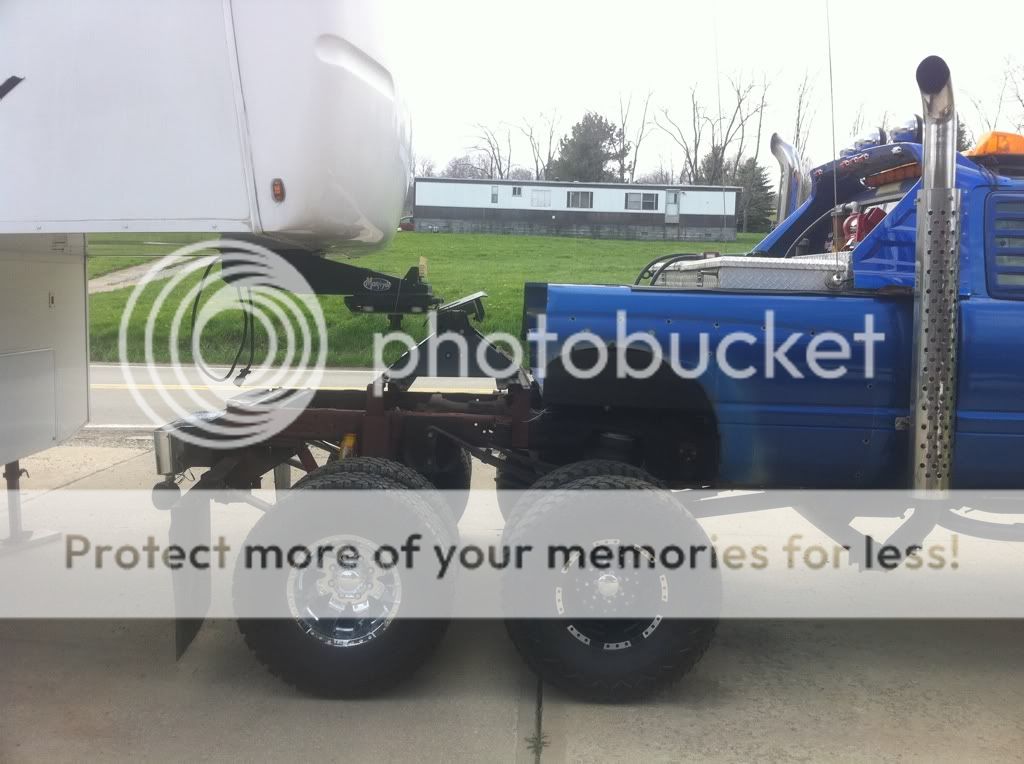
I don't think powering both axles will cause any binding. OTR tandem axle trucks power both axles through a common drive shaft and they don't have any issues. The tandem axles turn on a similar arc so there shouldn't be any windup in the drive line.
I am curious about two potential issues though:
How are you locating the secondary axle? Is it by a 4 link with air bags? It almost appears you have a 4 link suspension, however the links are pivoting from the rear of the frame? Have you thought about how this will function under load? Anti-squat comes to mind with the positioning of the links.
Second, if you are planning on using the secondary axle brakes, how will you tie those into the existing hydraulics? Have you come up with a master cylinder that has the capacity to move two additional wheel cylinders/calipers?
Finally, the drive shaft routing from the t-case will get interesting. It seems to me that it's going to take a lot of thought in the Ujoint phasing and angles to snake around the middle axle, and keep all the joints in companionship angles so that they cancel each others vibrations. There's always the CV route, but I don't think there's one in existence that can handle the torque of cummins.
Food for thought....
Thanks for giveing so much thought about this. I dont want to power both axles all the time. Just when needed. Most inportant is handeling. This RV weighs 3600 pin not loaded. That is allmost 2 ton. I just want a little help on a 1 ton truck. I dont want to get in to weight wars. But adding 2nd axle did add 7000 pound. And dont move to motor. Cause that motor is in very heavy duty trucks. I have 4.88 gears with a Gear Vender Tranny. I got most covered. I love input from you guys. But that is how big companys get ther R & D to build a better product. ( Research & Development) Granted most owners cant do this. Matthew_BExplorer
rock-rod wrote:
I don't think powering both axles will cause any binding. OTR tandem axle trucks power both axles through a common drive shaft and they don't have any issues. The tandem axles turn on a similar arc so there shouldn't be any windup in the drive line.
OTR trucks have two differentials in the front drive axle. Of course one is the regular left / right split; the second one is to split the torque between the axles.
The second differential is mounted lengthwise near the input yoke. The yoke from the drive line center drives the differential cross. The rear bevel gear is attached to the shaft going to the back yoke to drive the rear axle. The front bevel gear rides on the input shaft and then drives the pinion through a spur gear.- Matthew_BExplorer
Ductape wrote:
Part time operation unless you need the traction is a good idea. IIRC there were some Fords back in the 70's with a divorce mounted full time transfer case. NP203? If so a 203 may or may not be up to what that Cummins will send to it.
You can still find divorce mounted NP-203 cases. The worry would be that the case uses a chain for the front drive. The divorced cases are all the pre-77 models that had more problems with jumping chains.  rock-rodExplorerdefinitely an interesting idea...
I don't think powering both axles will cause any binding. OTR tandem axle trucks power both axles through a common drive shaft and they don't have any issues. The tandem axles turn on a similar arc so there shouldn't be any windup in the drive line.
I am curious about two potential issues though:
How are you locating the secondary axle? Is it by a 4 link with air bags? It almost appears you have a 4 link suspension, however the links are pivoting from the rear of the frame? Have you thought about how this will function under load? Anti-squat comes to mind with the positioning of the links.
Second, if you are planning on using the secondary axle brakes, how will you tie those into the existing hydraulics? Have you come up with a master cylinder that has the capacity to move two additional wheel cylinders/calipers?
Finally, the drive shaft routing from the t-case will get interesting. It seems to me that it's going to take a lot of thought in the Ujoint phasing and angles to snake around the middle axle, and keep all the joints in companionship angles so that they cancel each others vibrations. There's always the CV route, but I don't think there's one in existence that can handle the torque of cummins.
Food for thought....- tony_l1ExplorerAll I can say is Wow, I wish I had some of your talent and guts to try something like this.
 camp_nutExplorerCool project. I scrolled through the responses and didn't any from the weight police. I though they would jump all over you. You just have to watch and make sure those axels arn't locked at all when turning or you may not turn at all on dry pavement. Should handle anything you put behind it.
- SecuritiExplorer
SoCalDesertRider wrote:
Securiti,
Even though tandeming the truck is not how I would have gone about increasing the trailer towing or hitch weight hauling ability of the truck, it is an interesting and fun project none-the-less that I will follow as it progresses here on the forum. I lend my support to the idea. :)
Thanks - SecuritiExplorer
Bacon5 wrote:
First thing I thought of when I saw this was how many times I've been buried in the sand at Pismo Beach. I'm thinking you would have no issues there.
When should I have my truck delivered for the conversion?
Thank you. No apointments just yet. LOL - Bacon5ExplorerFirst thing I thought of when I saw this was how many times I've been buried in the sand at Pismo Beach. I'm thinking you would have no issues there.
When should I have my truck delivered for the conversion? - SecuritiExplorer
SoCalDesertRider wrote:
Ductape,
The NP203 is full time but can be converted to part time. It is a 2-section transfer case, one section for the range box (low gear) and one section for the f/r driveline split. The 2 sections of the t-case can be separated and used independently. It is common for rock crawlers to yank the range box section from an NP203 to use a 'doubler' in their drivetrain, since the 203 has a 2:1 low range. The NP203 and NP205 were made in the 70's and both have heavy duty iron cases and can handle quite a bit of torque output from the engine. The 205 is an all-gear part time t-case. The 203 uses chain drive with a center differential for full-time operation.
Thanks for info. Can use it all.
About Fifth Wheel Group
19,038 PostsLatest Activity: Apr 24, 2026
