
Forum Discussion

evy's avatar
evy
Explorer
Apr 26, 2014

Camping in cold weather vs plumbing & tanks

Ok so I red a lot of posts about insulating the campervan, I live near Montreal Canada, I'm thinking I want to have the possibility to camp out from mid March (23°F avg) to mid December (21°F avg), so it can get pretty cold (mostly at night).

Working on my design for a DIY campervan, I came up with a couple of ideas, please tell me what you think and what your experiences are.

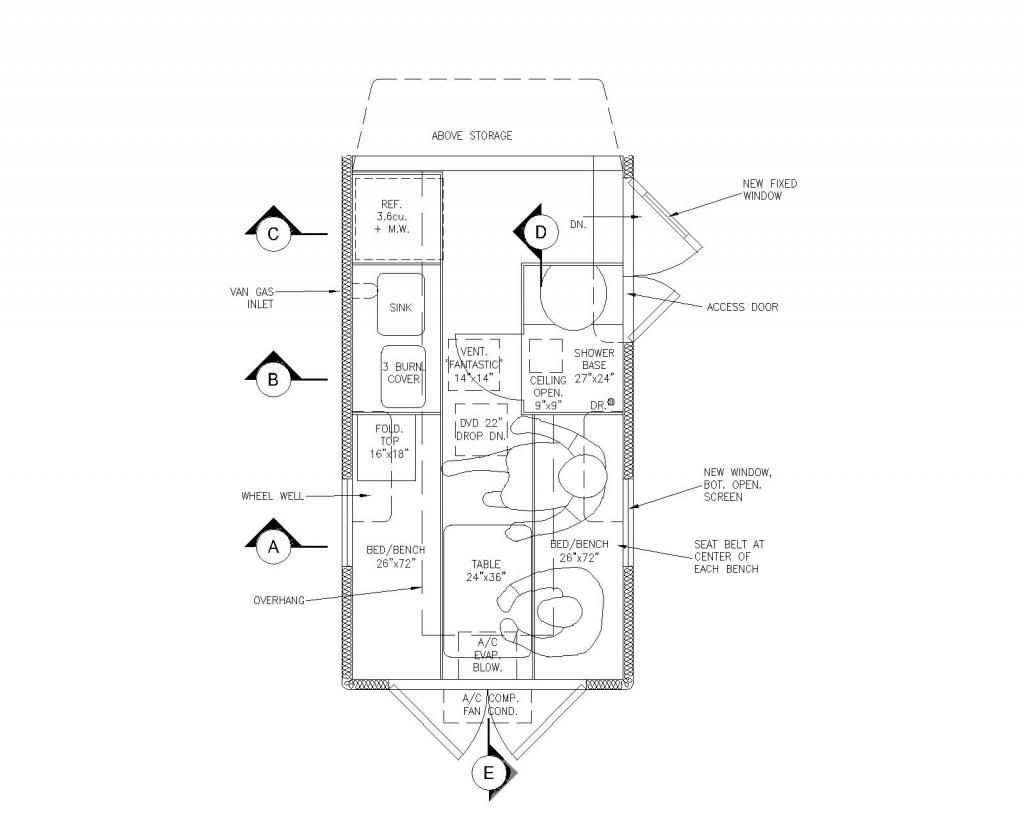
Basically I'm Trying to move all the water tanks inside the vehicle rather then under it :
-Fresh water tank with pump under the bench.
-Grey water tank under the bench next to the kitchen sink (gravity)
-Black water tank : Thetford cassette, under the toilet seat but above the van's floor
-Grey water from the shower : I was thinking making a 27"x24"x8"High shower base slopped to a SIDE drain connected to a small pump transferring the water to the grey water tank under the seat, maybe with a manual on/off switch (no floats)

As a result all the water pipes and tanks are above the van's floor and in the heated area. So no insulating the tanks or heating pads/wires under the van.

Am I forgetting anything?
Am I over thinking this?
17 Replies

  • I also use a Olympic Catalytic heater in the winter. It does not use any 12 volt power, and will put out about 6,000 Btu's of heat, you can keep warm, and even leave the windows open. You need to keep a roof vent open about 1/2" and a window open the same amount. This does use up some of your heat, but overall I can keep my well insulated 30' Bounder toasty warm at 19F outside with the CAT heater and a little time running the furnace.

    Fred.
  • Hi,

    Be sure to route pipes as far as possible from outside walls.

    Since you are designing from scratch, I'd plan on a heated basement.

    Water is heavy--having the tanks higher will raise the center of gravity.
  • I still think the Thetford Curve is a better option for a toilet. It has it's own water tank(no lines to freeze) and the same waste tank capacity as the cassette with less footprint in the shower area giving you more room. It is also a fraction of the price. I know you have made your decision but others learn from these threads so please be patient with my redundancy.
  • 1775 wrote:
    One of my water tanks in my B is inside the van and it is only protected if there is heat on inside the van 24/7. In the winter it gets very cold inside the van without the hear on. Plus in your design you have an access door at your toilet that is going to let a lot of cold inside right at a water location.


    My campervan will be stored in my heated garage when not in use.
  • One of my water tanks in my B is inside the van and it is only protected if there is heat on inside the van 24/7. In the winter it gets very cold inside the van without the hear on. Plus in your design you have an access door at your toilet that is going to let a lot of cold inside right at a water location.
  • Hi,

    This website might be helpful.

    Tank-Depot.com

    You might also consider that you will be camping longer when it is not cold, and that a grey water tank under the van might be helpful on longer trips?

    What about this. I installed a heater core in the back of my pickup, with a tee in each heater line under the hood, going through 5/8" lines under the truck to the heater core. In use, I could open a cargo access door, and turn on the heater fan, then blow warm air into the camper while driving. In actual use, more cold air came in, and the camper was barely warmed at all, but I was young and trying things out.

    For your case, a auxillary heater in the back, especially if near the fresh water tank can warm that area a lot, and the warm tank with 20 gallons of water (160 pounds) can give off heat all night long if warmed to say 80F and the area cools to 50F. 30F X 160 pounds = 4800 Btu's.

    Another Rv.Net user made a homemade heat exchanger for his water heater. Using 3/4" tubing, he had a tube going up from the outlet of the heater to a high point, then turn down to below the inlet, and piped back into the tank inlet. The tubing was located inside his camper. Because the 140F water is lighter than 90F water, the hot water flows out without a pump, cools off inside the camper, and flows back into the heater. The water heater is limited by it's 8,800 Btu capacity, and that the tubing surface area is pretty small heat exchanger, so it will not give off to much heat.

    It is something to think about though. If you have a heater line from your engine go to the dinette area, then a axillary heater, you can put some 3/4" copper tubing in that area, say after the water has been cooled by the heater, then it can warm that storage area. Using a ball valve, you can turn on flow when needed, and shut it off in the summer. You can use a switch near the heater core to turn it on and off as needed.

    Fred.