JBarca wrote:
Let me show and explain and you tell me where I go wrong or we have agreement.
EDIT 1-30-12 A point to clarify, we need to declare if the tongue jack is up or down supporting the TW when tightening the urethane springs. Odds are higher that the jack is down supporting the tongue.
If the tongue jack is up, then it depends on the stiffness of the rear springs of the truck in relation to the TW if the tongue will rise or the ball will drop.
My analogy of the coupler rising was based "no" jack being down and heavy truck suspension in relation to TT TW. That may not be a real condition in most cases as even I have the jack down... but it was how my brain was thinking about it at the time. And may be where the mix up of which part is moving up or down...LOL :B This is why diagrams are better then words most time... Put the tongue jack in the equation :S
I fail to see how the tongue jack makes any difference. As the chain tension increases, the forward thrust of coupler against ball increases. Whether the coupler then moves upward relative to the ball simply depends on the net direction (up or down) of vertical forces generated between coupler and ball. And those forces depend on shapes of the contact surfaces between socket and ball and between latch and ball. I don't think we can unequivocally say that "If the chain forces are high enough they will overcome the down force of the TW and the coupler will cam itself up."
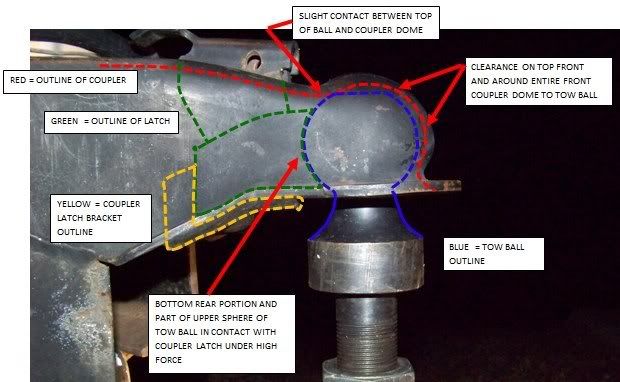
If we are in agreement here, (Yes/No?) then this comes down to the WD chain force.
Okay, let's assume the diagram for
your specific coupler accurately depicts the relative positions of ball and coupler components with springs tensioned. Then I also assume there must have been a gap between ball and coupler latch before the springs were tensioned. The tensioning of the springs then caused the coupler to move forward and upward (relative to the ball) until the coupler latch was firmly in contact with the ball.
Given these assumptions, I would guess that a relatively small forward thrust, perhaps equal in magnitude to the TW, would cause the coupler to ride up and over the ball to close the gap between ball and coupler latch. The relatively small force requirement would be due to the relatively flat slope of the socket/ball contact surface as you have depicted.
But, before becoming a completely agreeable person, I have to ask --
Is your coupler latch adjustable? If so, why should there be a gap between ball and coupler latch prior to spring tensioning? If there is no gap after the coupler is latched, the coupler latch cannot move forward relative to the ball and the coupler cannot rise up relative to the ball.
Also, even if what you have depicted for your particular coupler is an accurate representation, I'm sure there are many other coupler configurations which would produce different results. So again, I must believe we cannot be certain that coupler "lift" will occur.
The invite hint, hint was to help confirm that on my TT and TV to use as an example, that the force needed to be generated in the Anderson WD chains total would be approx. 7,800# to create what I declare is proper WD on this truck.
I have a 1,400# loaded TW, I run the WD so the front of the truck is approx 100 to 150# light on purpose. Partly due to 2 stage rear suspension that this truck is more stable when the helper springs just kiss the truck bracket and for the new SAE recommendation to help ward off oversteer.
I did not do the moments yet to confirm the reactions however if I was in the right league of 7,800# force pulling on an estimated 8" Anderson tow ball creating the 5,225 ft. lb of torque needed into the receiver for proper WD on the TV, then the 1,400# raw TW was not enough to hold down the TT tongue from not lifting "up" that 1/8".
Did I mess up seeing this?
PS the invite is still there on the WD chain force....LOL
John, I think you were in the right league with your chain force calculations. And, given the characteristics of your specific coupler (including the gap between ball and coupler latch), I agree a combined chain tension of 7800# certainly would cause the coupler to move forward and rise the 1/8".
However, although the Andersen hitch is rated for a TW of 1400#, I really doubt that they expect the hitch to generate enough WD torque to restore all the front end load which would be removed by a 1400# TW. And, if you're driving a 2011 or newer Ford truck, you only need to restore 50% -- according to Ford. :)
Ron


