Campin LI wrote:
BenK wrote:
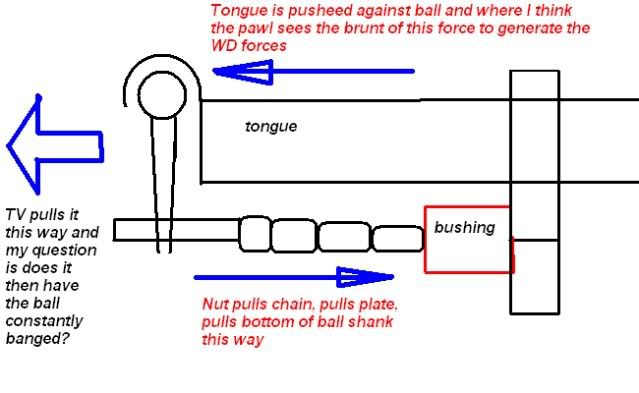
Using Bens diagram above, I agree the frame of the trailer is pushing towards the tow vehicle when the chain is tightened. No question.
I believe the bottom arrow is wrong. When the chain is tightened, it does not know it is tightened from one side. It is in tension and therefore pulling both sides, so the arrow should go both ways to demonstrate forces in both directions. The hitch ball is the hinge. You tighten the chain until the rectangle is formed. Once the rectangle is formed, the truck and trailer are leveled. This action also causes the hitch ball to rotate toward the truck which would set the pressure from the hitch pawl lower on the ball. I suppose some weight might be transferred forward but not knowing the math involved, I don't know how much is. I don't see any lever because the chain is not rigid, even its mount to the plate is not rigid. Technically, that is a hinge too. To me it looks like you tighten the chain and this action lifts the trailer tongue and hitch ball. I see that by over tightening the chain, the back of the truck would be lifted higher and that action would distribute weight forward, so I guess to some degree it does distribute weight, just not traditionally by prying.
Anyway, I'm not sure. Just throwing it out there.
Correct in the beginning sequence, but to complete that vector...as
the chain is tensioned it will pull from both ends.
The end on the tongue clamp is stationary, so it will pull the tongue towards the
ball shank plate.
Since the ball shank plate is connected to the ball shank, it will 'try' to come
towards the stationary clamp on the tongue.
That will then have the tongue move towards the ball
It will then bump into the ball and since the ball is inside the coupler. It will
contact the latch side of the coupler interior to complete this vector system
That then will have the ball shank 'try' to go off perpendicular. Since the ball
shank is captured inside the special shank with the tapered hole lined with
friction material...it will tilt the ball shank, which will tilt the shank,
which will impart a lifting moment on the receiver pin box, which will then
place that moment on the TV frame and distribute weight from the TV's rear
towards the TV's front.
The diagram is the end result and simplified as was lazy and didn't want to spend
the time to draw each moment and the resultant vectors
Then the other potential issues or weaknesses to this architecture
Whether the tongue rail clamps will hold. That is a LOT of force and
to use just frictional clamp is risky over time
The coupler latch taking the brunt of the forces on SOME of the coupler
designs. As some do NOT have the dome contact the ball in the rearward
direction of the ball


