Bruce H. wrote:
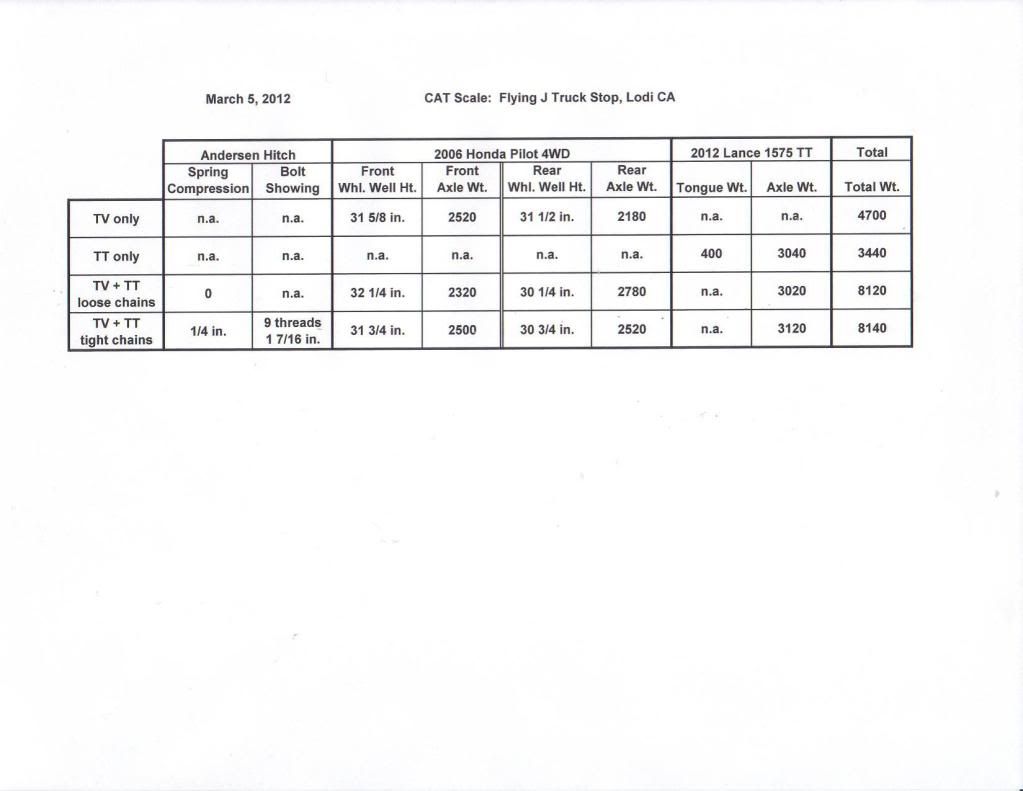
I adjusted the spring tension until the front fender was within 1/8", which amounted to 1/4" of spring compression. I am a newbie at this weight distribution stuff, but I am thinking that there may be a little too much weight distributed to the front axle and trailer axle. Would appreciate your input on this.
You will notice a 20 lb. discrepancy in the figures. Nothing changed in either the TV or TT that would cause that. I am surmising that the CAT scale weighs in 20 lb. increments and that maybe the rig was right on the bubble.
Am comtemplating another visit to the CAT scale where I measure and weigh each 1/16 increment of spring compression, up to 1/4 inch. This should give me the info need to "fine tune" the setup.
Hi Bruce,
Your spread sheet is great. Thanks for sharing. You have a smaller truck and camper but we can see what is going on at the axles.
The 20 lb difference you are seeing at the scales is scale error. It is common to see that much. Remember they also weigh 80,000# semi's with these same scales....
By your numbers your truck has took on 320# of the 400# of your TT tongue weight. And in your case the rear axle is holding the 320#.
I checked the Andersen manual that states this:
Andersen wrote:
The goal of the weight distribution system is to get the tow vehicle and trailer as level as you can. With that in mind, here is the OPTIMUM setting for most installations:
FRONT WHEEL WELL: the SAME or within 1" ABOVE the initial measurement you took on page 4
REAR WHEEL WELL: the SAME or LESS than the initial measurement (but not drastically less –see next page).
If you are already within the above parameters, then tow your trailer for a few blocks to let everything settle and remeasure. If everything is good, then you are at the optimum tension for towing your trailer.
I highlighted the wording "The same" on the rear axle as "optimum". They are shooting for a level truck it seems. Level can be hard to do pending the truck especially if the rear axle in high to start with. I'm not saying level is not good, but more about what the weights are doing verses being level and you have the weights.
There are many opinions on what is proper WD on a truck and one size does not always fit all. From my experience I would not recommend you go to the "same" on the rear axle. That will push more weight up front and lessen the weight on the rear. With only 320# added to the rear axle that is the added weight to help rear wheels traction on slippery surfaces. Making that less may break free traction in some cases.
What does Honda say in your owners manual for what proper WD is for this specific vehicle? Some times they do and some times they do not. Does your truck receiver have a "weight distributing" rating? I looked up a 2006 Honda Pilot and on page 217 of the owners manual version I found is says something about a WD hitch. The weights of your TT seem to be under what Honda recommends for "other" trailers then a boat. So weight wise things look in line including your GCW.
If you follow the guidelines of the new SAE recommendation they want the front a little lighter then they use to. They are worried about oversteer. The concern is a heavy front may bite in so to speak and send the truck and trailer into jack knife faster when turning.
I would not add any more weight up front. A small amount less may help with the new SAE guideline. I would check your owners manual on a WD hitch and what is the sticker rating on the truck receiver. By what little they said on a WD hitch you for sure do not want to take off any more weight off the rear axle and add any more to the front.
Good luck and hope this helps. You provided an excellent weight chart. Congrats on this now you know what is going on with the WD part.
John