Forum Discussion

ghsebldr's avatar
ghsebldr
Explorer
Jul 18, 2014

trading out 6 v for 12v

I know this has been beat to death here but before I fry something I would like some help. After looking at RoyB's diagrams I see that when going from 12v to 6v batteries that the 6v batteries should have a #4 wire running from the positive of one battery to the neg. of the other. (right so far?) Then the positive from the MH connects to the positive of one battery and the ground goes to the neg on the other battery. (still right?)
Now I was wondering if I can hook up a charge controller and an inverter to these batteries? And if so do they go to the same posts? I had these 6v's in a small home solar system and I think that was the way they were hooked up then.
Will it effect the MH's converter/ charger parallax 7345 to have the c controller and the inverter on these batteries.
Also do I need to shut off all breakers in the MH's fuse box? I did get a fuse holder and a 200 amp fuse that I will attach to the positive side of the battery before the inverter to protect the system.
Does this entire plan and set of questions make sense to anyone. I have been reading here on all of the subjects but am to the saturation point. I have read the solar posts that we are usually guided to that are very informative but by the time I get one idea set in my mind I get lost in several other pieces of the puzzle.
Just to confuse the issue a little more I have 2 100watt Renogy panels that I plan to set up on a temporary basis this winter at Quartzsite.I also have a Tracer 2210 http charge controller and a Xantrax prowatt 600 psw inverter.
Thanks for your help.

8 Replies

  • New converter is next.Thanks for the tip on the Progressives. Thanks Wa8
  • Somewhat off the subject, but still related.

    Your Parallax 7345 converter is a single stage converter. The output remains at 13.8v, high enough to boil the battery fluid but not high enough to charge the battery very fast. Modern converters are 3-4 stage. They start out with a voltage high enough to rapidly charge the battery then reduce the voltage to lower levels to finish the charge and maintain the battery charge.

    You might consider replacing your converter with a Progressive Dynamics series 4600 or 9200 or similar converter if you are planning to do much off grid camping.
  • wa8yxm's avatar
    wa8yxm
    Explorer III
    When using six volt pairs there are just two things you need to know, JUST 2

    The first is this: The jumper wire that connects the two needs to be the LARGEST wire connected to them. Generally the same size as the NEgative wire unless there are more than one on that terminal then combine them and make it that size.

    4GA is common, simply because it is easy to get ready made 4GA jumpers, Every auto parts place has them, commmon starter cable.

    Next: There are no six volt batteries in RVs.. Only 12 volt.. (Yes I know I have a pair of Deka G-20's six volt 230 amp hour)

    Here is why I say that.

    Once you hook up that jumper... Those two six volt batteries, Magically (Well there is not any magic involved) become one BIG 12 volt battery, treat the pair exactly as you would an 4-D 12 volt battery,, BOTH are 12 volts at 230 amp hours.

    ALL questions regarding the care and feeding and more are easily answered by thinking of the PAIR as a single 12 volt battery.

    How do I charge (Feed) them (Same as a 12 volt size 4D)
    and here are some other questions I've seen:
    Can one be old and one new
    Can one be big and one be small (See footnote)
    Can one be Flooded and one AGM
    Can one be Excide and one Deka (Different brands)


    All those can be answered by asking "Would you want a 12 volt battery that was half and half?)

    Footnote
    There was a thread on one of the forums about someone who DID want to mix a small and a large six volt.. This is the one time where you can not mix batteries of different size.

    You can mix a pair of Deka G-2 (210 amp hours) with a pair of G-20 (230)
    You can also mix a pair of Six volt (See above and pick one) with a group 27 (100 amp hour give or take) or even a 24 (75 amp hour)

    But only if you think of the six volt pair as a single 12 volt

    Batteries in parallel Add amp hours (Like the G-27, 24 and 4D (Pair of sixes))
    Batteires in series MUST be identical and you add voltage
  • RoyB's avatar
    RoyB
    Explorer II
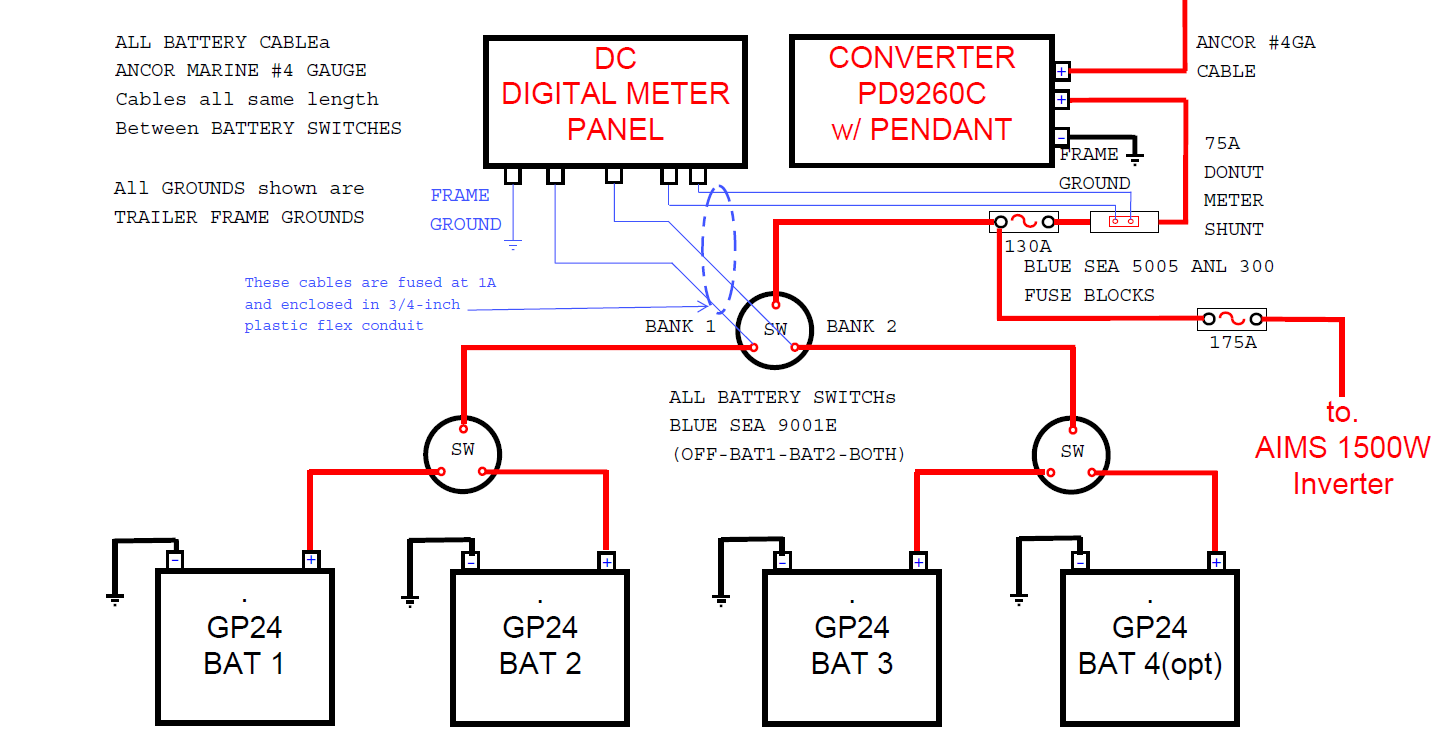
    This was my wiring setup plans for using two groups of Trojan T105 6VDC batteries in series to give me a 450AHs battery bank capacity...


    Some installers doesn't like my method of using frame ground to get my battery return cables connected but has worked fine for me over the years. I do use a separate frame ground connection for each cable.

    My best move was to the BLUE SEA four position battery switches in my setups. In this drawing the battery switch selects BANK 1 or BANK 2 or both or TOTAL OFF.

    In my other 12VDC Battery install diagram having two more of the BLUE SEA four position switches install gives the ability to connect to any one of the four 12VDC batteries or none. This is great for using alternate charging methods sometimes needed to charge some of the batteries when the other batteries are still connected to my setup and being used. I am presently still using this wiring setup but depending on my upcoming replacement batteries I may have to change my layout somewhat. My four 12VDC batteries were installed in late 2008 and I lost one right away because I let it boil out fluids on me before I caught it. Since 2009 after changing over to smart mode charging to last year I have been running three 12VDC Batteries but this season I have lost another 12VDC battery so down to two now in my setup (170AH capacity). Six years not bad for the abuse I have been giving my 12VDC standard issue 85AH GP24 Interstate batteries


    Camping off the power grid with just a 170AH battery capacity battery bank is not doing well with me... I am carrying a second truck start 12VDC battery which I already had just for PLAN Bs...

    Time to start looking for new batteries here... May add solar panels this time around as well... Solar panels should help out big time for when having to run my 2KW generator at 8AM each morning like I am doing now. My RULE NUMBER ONE is not ever start my day/night battery run unless my battery banks are re-charged up to at least 90% charge state.

    Roy Ken
  • You can consider the two 6v batteries in series as a single 12v battery. Nothing else connects to the wire between the 2 6v batteries.

    I would use the same size, or larger, wire between the batteries as is used to connect the RV to the batteries.
  • You have the total series wiring and connections to your batteries assumed correctly. No problems with connecting everything as you've posted. Your connections from the charge controller and inverter should be fused individually, according to the current assumed and ampacity of the wires. Xantrex will have a recommendation about fuse size as will probably the mfg of your charge controller.

    You will want to make sure that the onboard converter isn't powered when connecting to the batteries.
  • The inter battery jumper should be rated higher than the 200 fuse you are installing along with the ground and hot leads. I would use 1/0 or a smaller fuse.

    You do not small under sized wires to burn up before the fuse blows.

    Chris

About RV Tips & Tricks

Looking for advice before your next adventure? Look no further.25,186 PostsLatest Activity: Mar 11, 2026