time2roll wrote:
BFL13 wrote:
That bit in the previous post about the controller limiting its amps in Absorption is not right--the controller holds its voltage and the battery limits the amps.
The effect is the same. The controller stops and starts the electric flow to control the voltage but the actual function that is happening is the current flow (amps) is stopped momentarily.
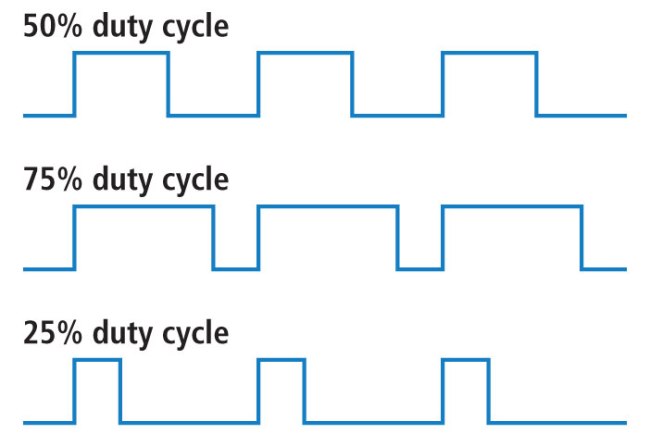
Note the voltage does not change, the total current (amps) is what changes.
This is the difference between talking about the effect vs what is actually happening digitally.
PWM is a strategy to control the average voltage - by changing the duty cycle you are controlling the average voltage. For PWM charge controller the battery is acting as an extremely large capacitor - ie it's voltage can only change slowly, so if you modulate the incoming voltage at frequency many orders of magnitude higher than the time constant of the battery (say 10 - 100's of kHz) the battery is in effect seeing the average voltage. A PWM charge controller measures the battery voltage and then uses a feedback loop to control the duty cycle on the transistor 'switch' in order to achieve the desired voltage (say 13.7V) - it does not regulate the current.


