Forum Discussion


DaHose
Jun 09, 2013Explorer
I got the call that my combiner came in on Friday, so I picked it up, planning to install today. I also checked my alternator and it is the single lug kind, so I won't be in a hurry to change that out.
As I was looking at things before tear down, I noticed that the regulator was one big pile of rust, which got me to thinking the regulator might actually be the problem. However, when I last switched around wires on the isolator, the rusted posts stripped and new nuts wore them down further. Even if the $25 replacement reg. were to fix the charging problem, I still wouldn't trust the aging isolator, so I went ahead and installed the combiner to clean up the whole shebang and remove all doubt about what parts might be on their way out.
Here is a pic. showing how much cleaner than OEM this new install turned out.
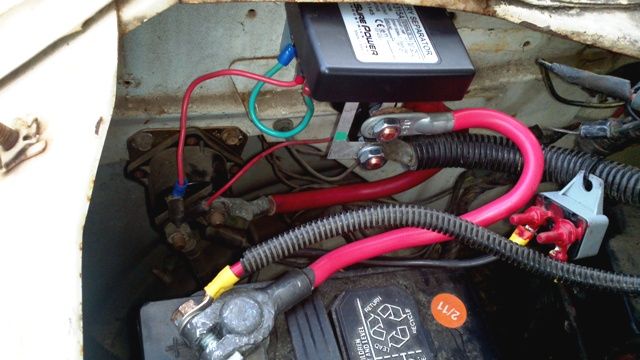
Installation was really easy. First I pulled out the main battery and disconnected the coach battery. I removed the isolator and extra solenoid, then connected both batteries to the appropriate posts of the combiner. I left them loose, so I could find the ideal spot for the combiner. I marked and drilled the holes, then mounted the unit. I tightened down the battery connectors and connected the ground spade terminal to one of the mounting screws. You might notice that I opted to have the starter solenoid and main battery on the same lug of the combiner and the alternator connected directly to the main battery. For the starter bridging feature, I chose to wire it up to bridge automatically. You can see the 12V trigger lead is connected to the starter solenoid hot lead. The batteries are automatically bridged to start up the engine, then separated when I let go of the key. I also won't need to worry about manually switching or disconnecting batteries for storage or when boondocking.
With the engine running, I tested voltage, watching as main battery voltage increased until it hit the switching threshold. Then I could hear the combiner bring the coach battery online, the voltage would even out and the coach battery was pulled offline again.
I still need to test on shore power to make sure my coach inverter charges both batteries, but I am positive that will work as well. Bottom line is that the combiner works GREAT!!! I highly recommend this upgrade to anyone who still runs a multi-component isolator setup. This is SO much cleaner and easy to troubleshoot.
Thanks for all the help folks. I hope this thread helps someone in the future.
Jose
As I was looking at things before tear down, I noticed that the regulator was one big pile of rust, which got me to thinking the regulator might actually be the problem. However, when I last switched around wires on the isolator, the rusted posts stripped and new nuts wore them down further. Even if the $25 replacement reg. were to fix the charging problem, I still wouldn't trust the aging isolator, so I went ahead and installed the combiner to clean up the whole shebang and remove all doubt about what parts might be on their way out.
Here is a pic. showing how much cleaner than OEM this new install turned out.
Installation was really easy. First I pulled out the main battery and disconnected the coach battery. I removed the isolator and extra solenoid, then connected both batteries to the appropriate posts of the combiner. I left them loose, so I could find the ideal spot for the combiner. I marked and drilled the holes, then mounted the unit. I tightened down the battery connectors and connected the ground spade terminal to one of the mounting screws. You might notice that I opted to have the starter solenoid and main battery on the same lug of the combiner and the alternator connected directly to the main battery. For the starter bridging feature, I chose to wire it up to bridge automatically. You can see the 12V trigger lead is connected to the starter solenoid hot lead. The batteries are automatically bridged to start up the engine, then separated when I let go of the key. I also won't need to worry about manually switching or disconnecting batteries for storage or when boondocking.
With the engine running, I tested voltage, watching as main battery voltage increased until it hit the switching threshold. Then I could hear the combiner bring the coach battery online, the voltage would even out and the coach battery was pulled offline again.
I still need to test on shore power to make sure my coach inverter charges both batteries, but I am positive that will work as well. Bottom line is that the combiner works GREAT!!! I highly recommend this upgrade to anyone who still runs a multi-component isolator setup. This is SO much cleaner and easy to troubleshoot.
Thanks for all the help folks. I hope this thread helps someone in the future.
Jose
About Technical Issues
Having RV issues? Connect with others who have been in your shoes.24,409 PostsLatest Activity: Aug 27, 2026


