Forum Discussion


JBarca
Feb 25, 2007Nomad II
Fellow Campers
I have been following this since it's start as I'm one of those happy Sunline camper owners now with no manufacture left to contact me. Mel, THANKS for compiling all this. When I first read this back in November, darn my model number was up as I have a 2004 camper. And I misread how to figure out the SN. So I thought I had one of the infected problem children. Then the serial number finder on the Dometic site appeared and lucky me. My serial number is past the affected units. :)
I have been on the hunt since Nov on and off to sort this out thinking I had suspect unit. Today I completed the first wave of findings.
Chris Bryant, thank you "again" for your site with technical details that we can use to help ourselves. And WillyB has been on the hunt for info as well.
Since mine unit is just past the ones with the issues, see if this info helps any. I could not get into the unit to see the actual inside of the boiler tube where the corrosion is supposed to start. I have some metal corrosion background from work and may be able to add something more here of an explanation if I can see the affected area. As this whole thing still does not 100% add up in my mind yet. The difference in a 354 watt heater and a 325 watt heater is not much. And if that little difference in heat sets this thing off into a corrosion reaction creating stress risers and then metal fatigue, boy are we really on the edge.
If any one has a pic of the inside please post. OR describe how to "easily" get the sheet metal tube off without taking 1/2 the unit apart. It was not cooperating and I was not going to push my luck.
Now to what I have. I'll do this with pictures as they tell a lot.
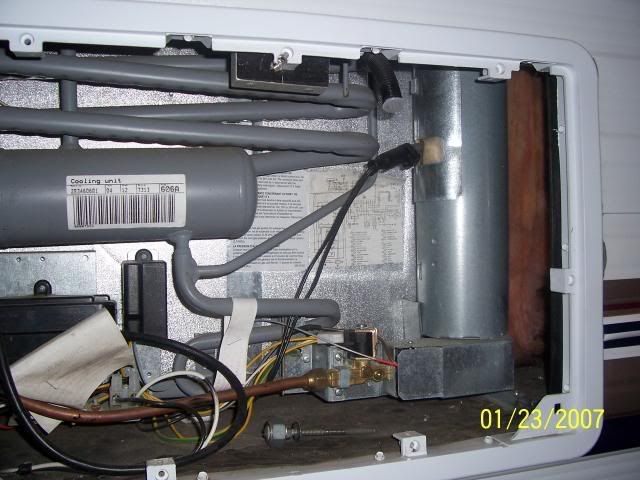
Here is the overall shot of the area in question. This is behind the outside vent cover.
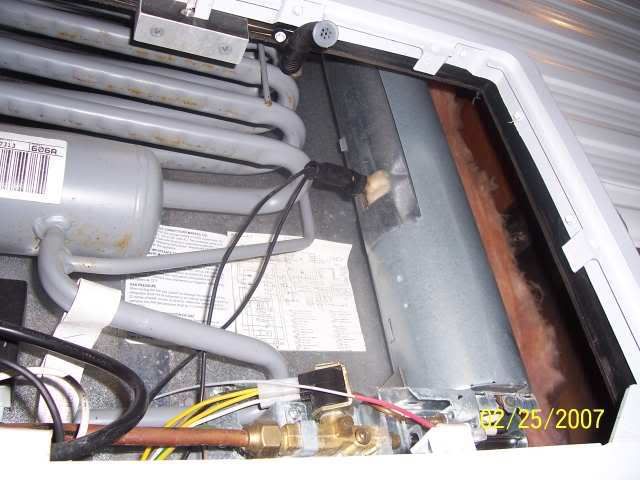
And here is a shot looking up the heating tube area.
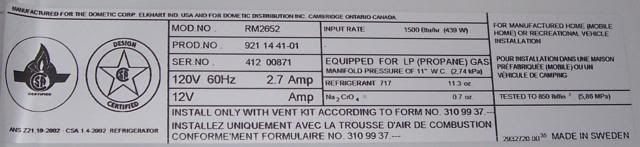
And here is the sticker inside the fridge showing the details of the unit.
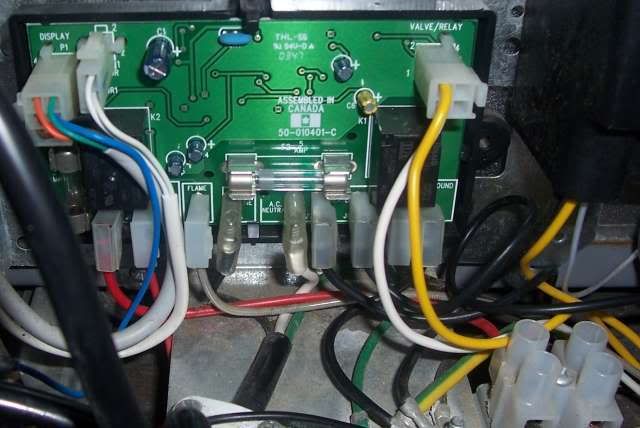
And now to some measurements on the heating element. First is the circuit board. Carefully take the heater leads off. Do not go yanking straight out on the circuit board as it could crack. A more up and down wiggle of the push tab and pull at the same time worked better.
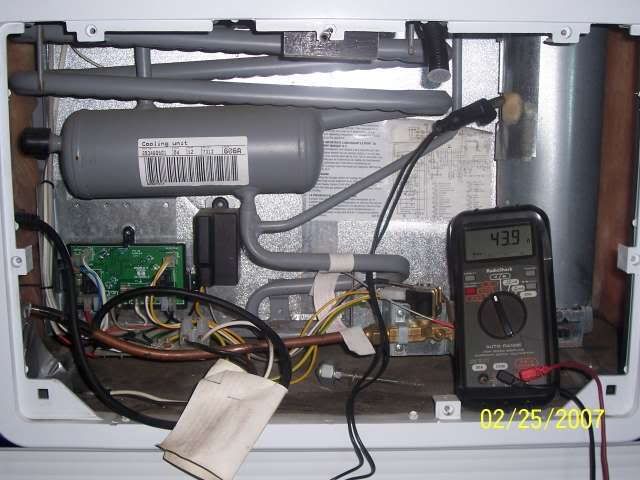
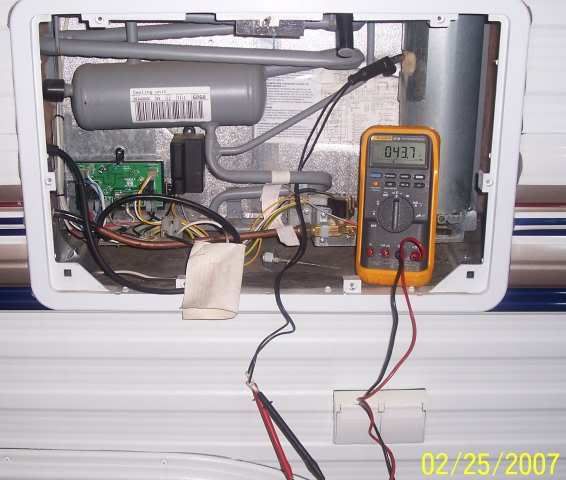
I used 2 meters to check ohms. And then used then against each other. As being off a few ohms means a lot here. Temp outside was 44 def F. as FYI.
Meter 1: (My Radio Shack Fluke meter wannna be. Actually they are private labeled for RS by Fluke I believe)
And my 2nd better meter:
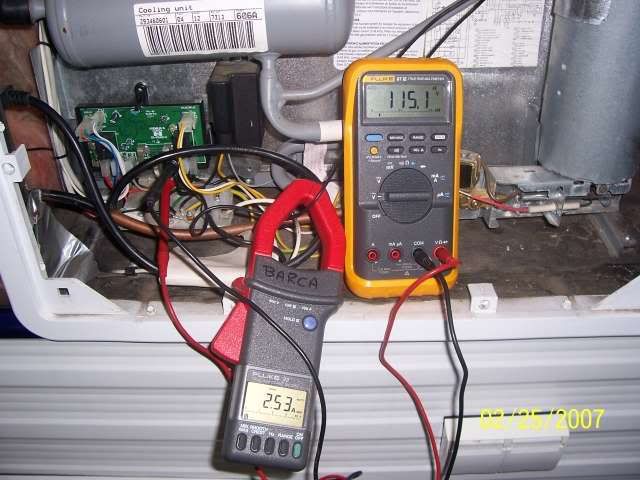
And now for a voltage and current check:
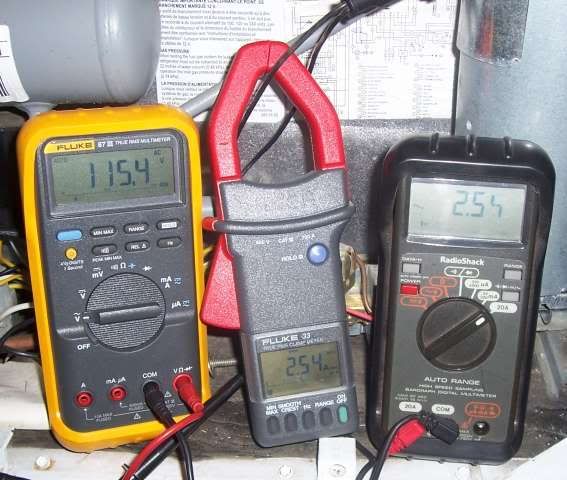
And since my amp probe is generally used for a lot more current than this, I checked it against a 20 amp full scale unit.
And now for the numbers I read off the actual heater element: (Had to use a mirror and flashlight to see them)
Stamped in the metal 1737680301 120V 325 W
Embossed in the plastic wire connection cap on the end of the probe: 385 03 33 PA667 EDIT: 3-4-07 The PN in red was taken using a mirror and flash light and reading the number in reverse order. After locating the Dometic parts list today for a RM 2652, the PN of the heater element is 0173768037. I have also noted there different models use differnt heater elements PN's.
That part number does not line up with the numbers on Chris's 2002 Dometic sheet. Since my unit is a 2004, it may be a new number.
Doing the power calculations.
On the first reading: 115.1 V at 2.53 A = 291.2 VA (watts)
On the second reading: 115.4 V at 2.54 A = 293.1 VA (watts)
Now thinking at other camp sites: Going to a full 125 volt camp ground and using my 43.9 ohm element. That is 2.85 amps, and 355.9 watts.
And using the nominal 120 V that the unit is rated for using my 43.9 measured ohms is 2.73 amps and 328.0 watts.
So again, if 354 watts of power sets off a corrosion reactions that starts metal fatigue and my unit which is suppose to be OK, I had better not plug it into a campground at a full 125 volts or else....
I guess an unknown answer is, people who actually have had failures and the higher rated wattage unit, do they actually plug into a high voltage campground? And those who do not have the problem, do they plug into lower voltage campgrounds? Good questions.
Now seeing this, I really need to see how the heater element is set up in the affected area where all this corrosion/metal fatigue is starting to at least put my curiosity at ease.
Hope this helps at least explain some of this to others. We really do not have a real good explanation of the problem.
Thanks
John
I have been following this since it's start as I'm one of those happy Sunline camper owners now with no manufacture left to contact me. Mel, THANKS for compiling all this. When I first read this back in November, darn my model number was up as I have a 2004 camper. And I misread how to figure out the SN. So I thought I had one of the infected problem children. Then the serial number finder on the Dometic site appeared and lucky me. My serial number is past the affected units. :)
I have been on the hunt since Nov on and off to sort this out thinking I had suspect unit. Today I completed the first wave of findings.
Chris Bryant, thank you "again" for your site with technical details that we can use to help ourselves. And WillyB has been on the hunt for info as well.
Since mine unit is just past the ones with the issues, see if this info helps any. I could not get into the unit to see the actual inside of the boiler tube where the corrosion is supposed to start. I have some metal corrosion background from work and may be able to add something more here of an explanation if I can see the affected area. As this whole thing still does not 100% add up in my mind yet. The difference in a 354 watt heater and a 325 watt heater is not much. And if that little difference in heat sets this thing off into a corrosion reaction creating stress risers and then metal fatigue, boy are we really on the edge.
If any one has a pic of the inside please post. OR describe how to "easily" get the sheet metal tube off without taking 1/2 the unit apart. It was not cooperating and I was not going to push my luck.
Now to what I have. I'll do this with pictures as they tell a lot.
Here is the overall shot of the area in question. This is behind the outside vent cover.
And here is a shot looking up the heating tube area.
And here is the sticker inside the fridge showing the details of the unit.
And now to some measurements on the heating element. First is the circuit board. Carefully take the heater leads off. Do not go yanking straight out on the circuit board as it could crack. A more up and down wiggle of the push tab and pull at the same time worked better.
I used 2 meters to check ohms. And then used then against each other. As being off a few ohms means a lot here. Temp outside was 44 def F. as FYI.
Meter 1: (My Radio Shack Fluke meter wannna be. Actually they are private labeled for RS by Fluke I believe)
And my 2nd better meter:
And now for a voltage and current check:
And since my amp probe is generally used for a lot more current than this, I checked it against a 20 amp full scale unit.
And now for the numbers I read off the actual heater element: (Had to use a mirror and flashlight to see them)
Stamped in the metal 1737680301 120V 325 W
Embossed in the plastic wire connection cap on the end of the probe: 385 03 33 PA667 EDIT: 3-4-07 The PN in red was taken using a mirror and flash light and reading the number in reverse order. After locating the Dometic parts list today for a RM 2652, the PN of the heater element is 0173768037. I have also noted there different models use differnt heater elements PN's.
That part number does not line up with the numbers on Chris's 2002 Dometic sheet. Since my unit is a 2004, it may be a new number.
Doing the power calculations.
On the first reading: 115.1 V at 2.53 A = 291.2 VA (watts)
On the second reading: 115.4 V at 2.54 A = 293.1 VA (watts)
Now thinking at other camp sites: Going to a full 125 volt camp ground and using my 43.9 ohm element. That is 2.85 amps, and 355.9 watts.
And using the nominal 120 V that the unit is rated for using my 43.9 measured ohms is 2.73 amps and 328.0 watts.
So again, if 354 watts of power sets off a corrosion reactions that starts metal fatigue and my unit which is suppose to be OK, I had better not plug it into a campground at a full 125 volts or else....
I guess an unknown answer is, people who actually have had failures and the higher rated wattage unit, do they actually plug into a high voltage campground? And those who do not have the problem, do they plug into lower voltage campgrounds? Good questions.
Now seeing this, I really need to see how the heater element is set up in the affected area where all this corrosion/metal fatigue is starting to at least put my curiosity at ease.
Hope this helps at least explain some of this to others. We really do not have a real good explanation of the problem.
Thanks
John
About Technical Issues
Having RV issues? Connect with others who have been in your shoes.24,410 PostsLatest Activity: Aug 30, 2026


