MEXICOWANDERER wrote:
I haven't used the term "110" or "220" for many decades. Curiosity overwhelms me, are there any licensed electricians here on this forum that do not use 120 - 240 - 480 - 600 volts?
I think one reason you still hear voltages like 110, 115 & 117 or 220 & 230 being mentioned sometimes is because some equip. or appliances can be rated & labeled for operation at lower voltages than the nominal 120 or 240 volts. It's common on motors for ex. because it's takes into account the voltage that will actually be at the motor terminals under load. To add even more confusion, plugs & receptacles have a "125 volt" or "250 volt" rating on them.
Maybe RVs should be rated 110 volts because that's often all you get due to CG wiring. :M
soren wrote:
The saddest part, as an electrician, is that a 30 Amp RV receptacle has "30AMPS 125 VOLTS" molded right into the front of the receptacle.
Yep, imagine if one of those electricians that can't read was working in say a hospital. Oops, so sorry (runs out door never to be seen again)... :E Fortunately, they need a higher level of qualification so not to worry. Never fails to surprise me how a bonafide licensed electrician can wire an RV outlet wrong, but every year there's posts about it happening across the country.
2oldman wrote:
I guess that about covers it.
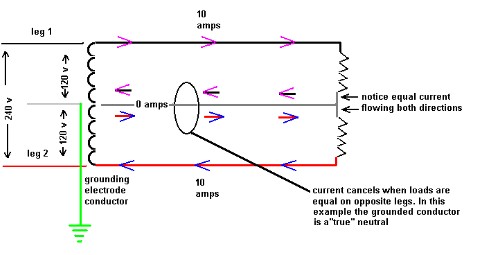
Um, well, maybe not... :) To make it more interesting, the neutral is there to carry the imbalance between one 240 volt leg and the other. So if you had exactly 10 amps flowing on one leg and exactly 10 on the other, there'd be no current flowing on the neutral. See diagram below. So does that mean you could do without the neutral in that case? Nope, don't even think about it.