Forum Discussion

otrfun's avatar
otrfun
Explorer II
Jul 20, 2013

Inverter Question

Searched various threads pertaining to "inverter installations". Obviously, the installs range from simple to elaborate.

The most simple seems to involve wiring an inverter to the battery and simply using 110v extension cords to directly power small applicances. Everything is functionally independent and separate from the TT's 110v outlets.

The most complex seem to have manual/auto switching of the entire TT to accommodate generator, shore, or inverter power.

I get the impression one moderately simple installation option could involve installing an inverter using heavy gauge wire connected to the battery. The inverter output could then be wired to an outlet somewhere outside the TT---in a convenient location that would allow the TT's main power cord to be easily connected. Of course, you couldn't power the a/c, and you'd want to make sure the converter is off, and the frig and water heater is on gas.

Assuming the worst:

1) I assume attempting to power the a/c (or any high amp device) would cause the inverter to simply overload and shut down with no damage to anything, right?

2) Do you risk damaging the converter or inverter if you accidently plug the TT's main power cord into the inverter with the converter still turned on? Since the converter would be attempting to charge the very same battery the inverter is using to power the converter---seems like a potentially vicious loop that could cause some damage. Does the potential for damage exist in this scenario?

Thanks!

36 Replies

  • 1.) Yes you can do what you describe. Mena661 has a great layout to follow

    2.) No, running converter won't hurt anything but if you do forget to turn it off you will waste a lot of battery power and deplete them quicker

    Unless you are trying to run the microwave for short periods of time and have a large battery bank (4 6volts or better) I would suggest a small inverter sized just over what ever devices you are trying to power. Cost less money and wastes less energy

    How do you plan to recharge batteries in the places you describe? You either need enough battery bank to accommodate the time you plan to be there with inverter use or solar to recharge if generator/shore is not available.
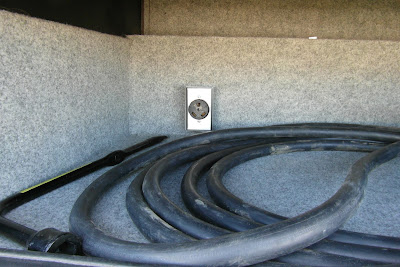
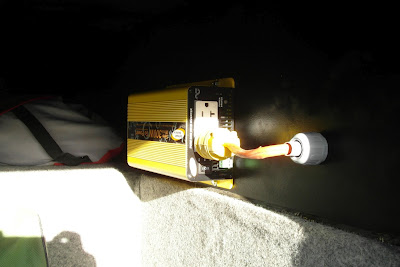
  • Who said anyone runs their inverter 24/7? Anyways, I run mine whole house. I have a 30A RV receptacle in my shore cord compartment. The receptacle is wired to my 300W inverter. I plug the MH's shore cord into the 30A. I turn off the converter. When my inverter overloads, it just shuts off. I simply turn it back on.

    30A RV Receptacle


    Inverter with 20A plug wired to 30A RV Receptacle on other end
  • otrfun wrote:
    naturist wrote:
    Please understand, I'm not trying to be a smart alec.

    (1) I wouldn't be surprised to find (from folks more qualified than I am to answer this) that serious damage would be likely if the converter and inverter were run together. Think feedback loop . . . .

    (2) I do not understand why anyone in their right mind would want to do this anyway. It simply makes no sense to even attempt it. Get an adequate (for whatever load you plan to run) generator and don't attempt to create a perpetual motion machine.

    (3) Do be aware that substantial loads will suck the life out of your batteries very quickly, unless you happen to have an 18 wheeler full of them at hand. This is WHY they sell generators at the RV store.

    May I suggest you simply tell us exactly what you are trying to power and why you need it.

    Wow, I kinda get the impression you're not a big fan of inverters :)

    Anywhoser, I already have a 3000w inverter generator and use it whenever possible. I'm trying to power small 110v appliances in various areas where generators are not allowed and shore power is unavailable.

    As for "why" I need to power these appliances, well, you'll have to trust me when I say it's important :)

    What do you suggest?


    The idea is to CONSERVE power.

    Needlessly running and inverter 24/7 wastes a lot of power, the bigger of inverter the more power used under light or no loads.

    Example, a 300W inverter no load current draw might be .5A at 12V, run that 24/7 and you will use 12Ahr of battery. a 2000W inverter may draw 2A at 12V and run it 24/7 and you will use 48Ahr of battery capacity.

    While this sounds great on paper you need to take into account of the losses in this whole plan.

    Batteries are nothing more than a storage device for energy, this device wastes energy when discharging AND charging. Take 48Ahr out of a battery and it will take 55Ahr perhaps 60Ahr or more to fully charge your battery.

    Additionally, while folks tend to get creative with finding ways to connect an inverter to their existing 120V wiring, done wrong and you can create a lot of smoking damaged equipment.

    Yes, folks have plugged the trailer shore cord to an inverter and yes, it can be made to work one must REMEMBER to turn off ALL HEAVY CURRENT DEVICES along with many other devices which appear to be harmless.

    Things like the FRIDGE (which WILL automatically switch to 120V when the control boards sees 120V), the fridge heater uses 275W-325W and depending on the model may have TWO heating elements.

    Hot water tank electric heater needs turned off, microwave, air conditioner, CONVERTER (converter will attempt to recharge the batteries from the inverter power thus wasting a lot of power) and so on would need to be turned off.

    So you are left with this conundrum of remembering to switch nearly every breaker off in the panel and IF you are "lucky" you MIGHT have just ONE actual usable circuit.

    If you WANT a whole house inverter, you are far better off installing one that has a built in transfer switch, then place the circuit(s) that you want powered on that inverter. Saves you hassle in the end.

    Personally, if money is the issue, install a SMALL inverter just big enough to power what you want, then run YOUR OWN AC wiring from the inverter to a couple of NEW outlet boxes that YOU install. Simple, quick and no switches or breakers to "remember" to flip.
  • otrfun wrote:
    1) I assume attempting to power the a/c (or any high amp device) would cause the inverter to simply overload and shut down with no damage to anything, right?

    2) Do you risk damaging the converter or inverter if you accidently plug the TT's main power cord into the inverter with the converter still turned on?
    1) It's up to your complement of batteries to handle a load. That's where your overload will happen... on the 12v side. The voltage will drop too low. No, it won't damage things.

    2) No.

    Congratulations on your decision to use one instead of running a generator for every little thing.
  • naturist wrote:
    Please understand, I'm not trying to be a smart alec.

    (1) I wouldn't be surprised to find (from folks more qualified than I am to answer this) that serious damage would be likely if the converter and inverter were run together. Think feedback loop . . . .

    (2) I do not understand why anyone in their right mind would want to do this anyway. It simply makes no sense to even attempt it. Get an adequate (for whatever load you plan to run) generator and don't attempt to create a perpetual motion machine.

    (3) Do be aware that substantial loads will suck the life out of your batteries very quickly, unless you happen to have an 18 wheeler full of them at hand. This is WHY they sell generators at the RV store.

    May I suggest you simply tell us exactly what you are trying to power and why you need it.

    Wow, I kinda get the impression you're not a big fan of inverters :)

    Anywhoser, I already have a 3000w inverter generator and use it whenever possible. I'm trying to power small 110v appliances in various areas where generators are not allowed and shore power is unavailable.

    As for "why" I need to power these appliances, well, you'll have to trust me when I say it's important :)

    What do you suggest?
  • Please understand, I'm not trying to be a smart alec.

    (1) I wouldn't be surprised to find (from folks more qualified than I am to answer this) that serious damage would be likely if the converter and inverter were run together. Think feedback loop . . . .

    (2) I do not understand why anyone in their right mind would want to do this anyway. It simply makes no sense to even attempt it. Get an adequate (for whatever load you plan to run) generator and don't attempt to create a perpetual motion machine.

    (3) Do be aware that substantial loads will suck the life out of your batteries very quickly, unless you happen to have an 18 wheeler full of them at hand. This is WHY they sell generators at the RV store.

    May I suggest you simply tell us exactly what you are trying to power and why you need it.

About Technical Issues

Having RV issues? Connect with others who have been in your shoes.24,373 PostsLatest Activity: Apr 02, 2026