Forum Discussion


myredracer
Jun 14, 2015Explorer II
Too much guesswork. Low voltage would be the top suspect and is a common issue esp. during hot spells with many users running AC units. Then the AC itself.
First thing I would do is get a voltmeter and see what the voltage inside is like with as many loads off as possible, then turn some loads on one at a time and see what the voltage does. If relatively stable with increased load, it's likely low CG voltage. If it drops as you add load, then you have pitted/dirty shore power cord blades (maybe inside the pedestal too) and/or poor connection(s) somewhere. If it happens all the time wherever you camp, it's more likely the latter.
If the pedestal has a 50 amp recept., it can help to use a dogbone adapter to get a better connection (50s are typically in better shape).
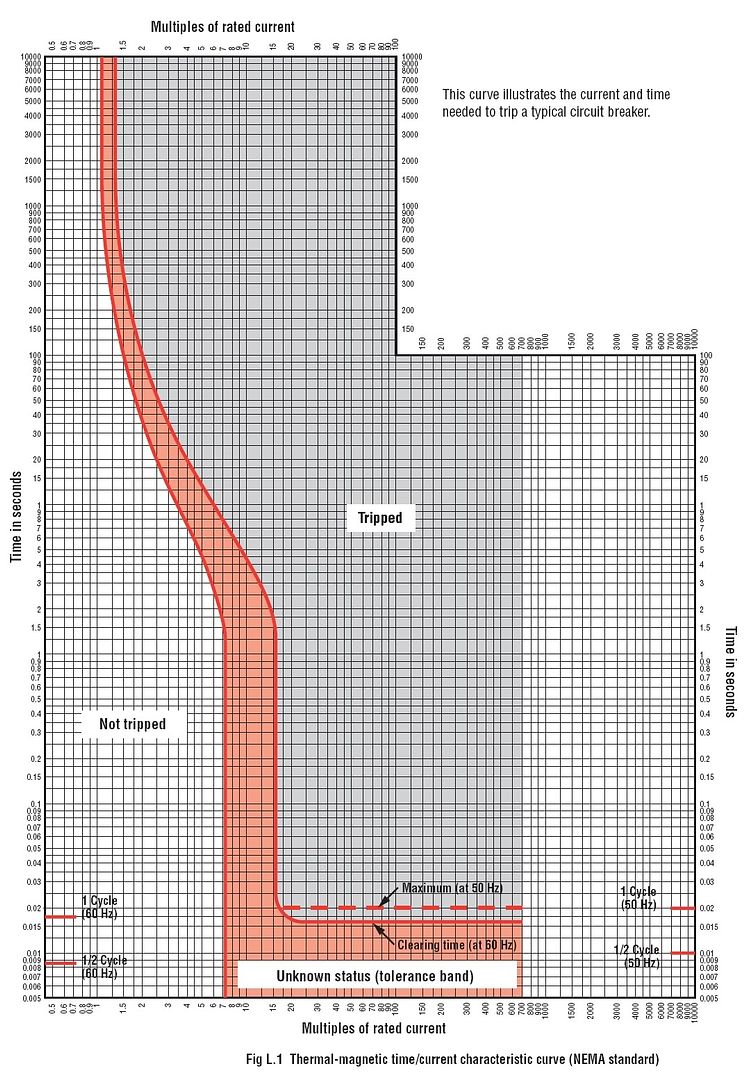
The graph below shows a typical time-current graph for a molded case circuit breaker like in an RV or residential panel. A clearer graph can be found HERE farther down. These graphs read in multiples of it's rated current. A properly operating breaker should run indefinitely at it's rating, or 30 amps in the OP's case. There is an allowable operating tolerance as shown in the graph and a 30 amp breaker could possibly run indefinitely as high as approx. 1.3 x 30 = 39 amps. This is why one breaker can trip before the other. Has nothing to do with statistical averages. Ambient temp. is also another factor - will trip faster the hotter it gets (current rating is at 40 deg.C ambient).
The NEC normally does not allow the load on a circuit to exceed 80% of it's rating, but for RVs, this is not a factor and things simply keep getting turned on and plugged in until a 30 or 50 amp breaker pops.
An AC unit will draw more current as voltage goes down. An AC unit can momentarily draw up to 6 times the full load rating. For say 12 FLA, that would be 72 amps at startup. Then you would add other running loads inside the RV, so for say 20 amps, the would be total 72 + 20 = 92 amps at AC startup. Then if you throw in higher AC unit draw due to low voltage and maybe faster tripping time due to high temp. (above 40C), a 30 amp breaker in a converter panel or pedestal could trip. (Impossible to predict.)
In the majority of cases, a 30 amp service should be fine running an AC unit and MW, assuming voltage is at or near 120V since a MW is not usually running for long periods of time. Looking at the time-current graph, you should for ex., be able to run 45 amps for up to about 20 minutes...
First thing I would do is get a voltmeter and see what the voltage inside is like with as many loads off as possible, then turn some loads on one at a time and see what the voltage does. If relatively stable with increased load, it's likely low CG voltage. If it drops as you add load, then you have pitted/dirty shore power cord blades (maybe inside the pedestal too) and/or poor connection(s) somewhere. If it happens all the time wherever you camp, it's more likely the latter.
If the pedestal has a 50 amp recept., it can help to use a dogbone adapter to get a better connection (50s are typically in better shape).
The graph below shows a typical time-current graph for a molded case circuit breaker like in an RV or residential panel. A clearer graph can be found HERE farther down. These graphs read in multiples of it's rated current. A properly operating breaker should run indefinitely at it's rating, or 30 amps in the OP's case. There is an allowable operating tolerance as shown in the graph and a 30 amp breaker could possibly run indefinitely as high as approx. 1.3 x 30 = 39 amps. This is why one breaker can trip before the other. Has nothing to do with statistical averages. Ambient temp. is also another factor - will trip faster the hotter it gets (current rating is at 40 deg.C ambient).
The NEC normally does not allow the load on a circuit to exceed 80% of it's rating, but for RVs, this is not a factor and things simply keep getting turned on and plugged in until a 30 or 50 amp breaker pops.
An AC unit will draw more current as voltage goes down. An AC unit can momentarily draw up to 6 times the full load rating. For say 12 FLA, that would be 72 amps at startup. Then you would add other running loads inside the RV, so for say 20 amps, the would be total 72 + 20 = 92 amps at AC startup. Then if you throw in higher AC unit draw due to low voltage and maybe faster tripping time due to high temp. (above 40C), a 30 amp breaker in a converter panel or pedestal could trip. (Impossible to predict.)
In the majority of cases, a 30 amp service should be fine running an AC unit and MW, assuming voltage is at or near 120V since a MW is not usually running for long periods of time. Looking at the time-current graph, you should for ex., be able to run 45 amps for up to about 20 minutes...
About Technical Issues
Having RV issues? Connect with others who have been in your shoes.24,363 PostsLatest Activity: Mar 05, 2026


