Finally, it took me long enough to find it again
PDF link at bottom
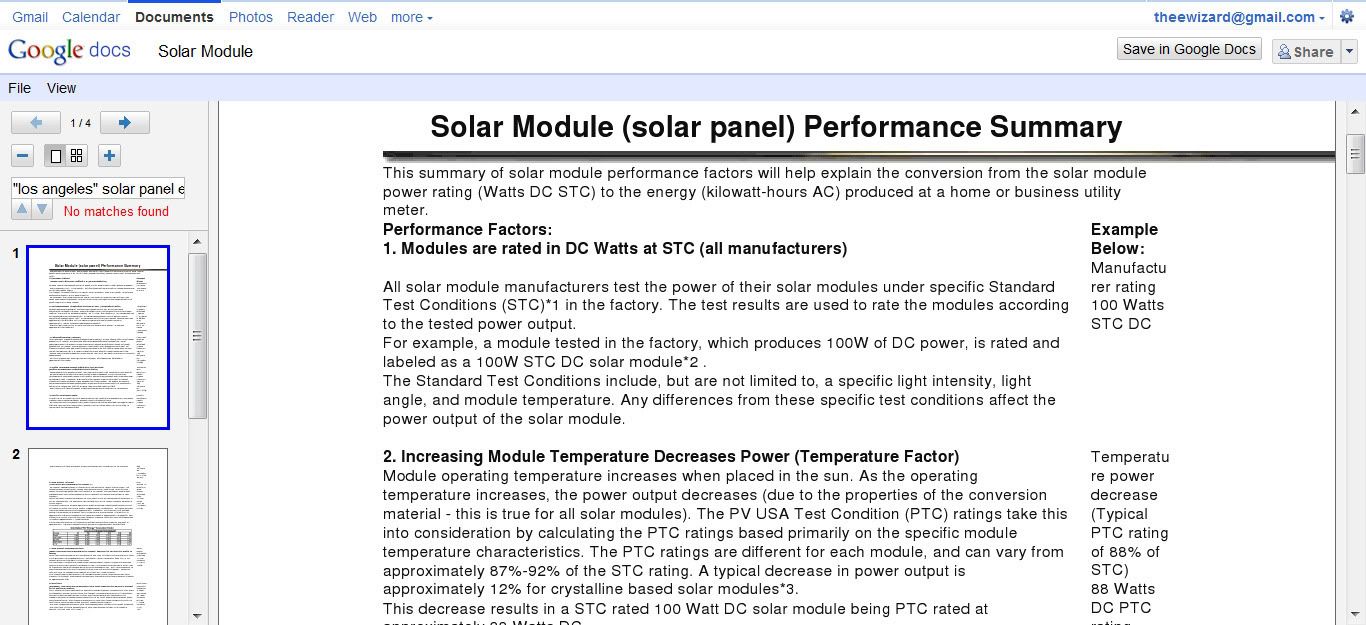
Excerpts
All solar module manufacturers test the power of their solar modules under specific Standard
Test Conditions (STC)*1 in the factory. The test results are used to rate the modules according
to the tested power output.
For example, a module tested in the factory, which produces 100W of DC power, is rated and
labeled as a 100W STC DC solar module*2 .
The Standard Test Conditions include, but are not limited to, a specific light intensity, light
angle, and module temperature. Any differences from these specific test conditions affect the
power output of the solar module.
In Southern California, a typical optimum tilt angle for average module power production over the course of a year in a fixed tilt system is approximately 30 degrees*7.
The typical Southern California residential roof is tilted approximately 15 degrees. The reduction in the average annual energy output for a module, which is mounted at a South facing, 15-degree tilt, is approximately 3% when compared to the optimal tilt angle of approximately 30 degrees.
This results in the energy (from one sun hour exposure-1000W/m2 over one hour) decreasing from 73 Watts to approximately 71 Watt-hours AC.
For flat mounted systems, the reduction in average annual energy output for a module is
approximately 11% when compared to the optimal tilt of approximately 30 degrees*8 .
(again "how much sun is shining on the module" based on the direction the system is
facing)
As the sun moves across the sky throughout the day, from the East in the morning to the West
in the afternoon, the compass direction, "orientation", (South, Southwest, East, etc.) of the
module affects the cumulative energy output.
For this reason, it is optimal to install a South-facing module in order to obtain the maximum
amount of direct light exposure throughout the day. If the module is facing East or West, it will
be exposed to less direct sunlight as the sun moves across the sky. There is no loss factor for
south facing modules*8, so the estimated energy (from one sun hour exposure-1000W/m2
over one hour) for this particular example will remain at 71 Watt hours AC.
If the module was not facing South, the estimated module energy output would have been
reduced. For example, a Southwest-facing module estimated energy output would be reduced
by approximately 3%.
South facing orientation
(0% loss)71 Watt hours AC(71 Wh x 100%)
8. Sun Hours
(and again, "how much sun is shining on the module" based on the amount of sunlight
for the particular location)
Every location on earth has a different amount of sunlight exposure throughout the year, which
is measured in kWh/m2 or Sun Hours. For example, a coastal California city like Long Beach
will have a lower average amount of yearly Sun Hours than a desert California city like
Dagget*9 because of coastal fog and moisture in the air. Since solar modules produce power,
and resulting energy, when exposed to sunlight, the more Sun Hours a location receives, the
more energy will be produced from a module installed at that location.
"One Sun" is approximated as the peak noon sunlight power intensity in the middle of summer.
"One Sun Hour" is energy produced by the peak noon sunlight intensity in the middle of
summer, over one hour. See Figure 1
Sun Hours
(Southern California -5.5 daily sun hours)
391 Watt hours AC per day(71 Watt hours AC x 5.5)142
Recorded sun hour data for particular locations is used to help approximate the energy
produced by a module, as it is the energy from the sun that is converted to energy from the
solar module.
The amount of Sun Hours for one particular location differs from day to day. There are multiple
Sun Hour data sources which slightly differ from one another. The U.S. Department of Energy
and NASA have recorded this data for over 20 years and have calculated average daily sun
hour data for most locations, which helps predict yearly energy output.
This recorded data shows an approximate daily Sun Hour average of 5.5 hours throughout the
year for many Southern California locations.
The Sun Hours during the summer season average approximately 7.1 hours per day and the
Sun Hours during the winter season average approximately 3.9 hours per day*10.
These seasonal averages result in an average of approximately 5.5 Sun Hours per day (7.1 + 3.9 / 2
= 5.5).
In order to estimate the yearly energy production of a solar module, one simply multiplies the estimated module energy output (from one sun hour exposure-1000W/m2 over one hour), 71 Watt hours AC, by the amount of Sun Hours for the particular location, 5.511.
This results in approximately 391 Watt hours AC per day or .391 kWh AC per day.
When estimating yearly energy production, the estimated daily energy production, .391 kWh
AC, is multiplied by the total number of days in the year, 365.
This results in approximately 142 kWh AC energy production.
One 100 Watt DC module will produce approximately 142 kilowatt hours AC of energy under
the specified conditions in this example.
kWh/year
(.391
kWh/day x
365 days
in So Calif a 100 watt panel can be expected to produce 73 watts when tilted to the sun, the 71 watts AC is factoring in a 2 watt conversion loss for "GRID TIE" systems
http://www.usrea.org/documents/Solar-Module.pdf


