Forum Discussion


Ron_Gratz
Oct 26, 2015Explorer
TundraTower wrote:
IF you have a single trailer axle I think you will see some change at the tongue - but at 22 feet and 6500 lbs this MUST(?) be a double axle. If you have a double trailer axle, the calculation gets messy and the impact at the tongue is probably less because the pivot point at the wheels is almost 5 feet long and provides resistance to the teeter-toter effect of the weight change.
No extra charge: you will be adding load on your trailer wheels equal to 230-T
Change to WD hitch probably depends on number of axles, whether the WD hitch is adjusted correctly before the new load is added, and whether the current adjustment is light or aggressive. We pull a 7600 lb trailer with a '13 Tundra and I have to set my Equalizer hitch very aggressive to push the front of the truck down due to the length(double cab). If yours pulls OK now, I would be shocked if you had to adjust it for 230 lbs on the back.
mosseater wrote:The previous quotes correctly speculate that distance between axles and spring compression can affect the relationship between load added at the rear and resulting load removed at the front.
My trailer has a huge cargo bay in the rear bedroom area and I put a whole bunch of weight back there. Firewood, 3 bikes, drinks, probably well over 500 lbs. It takes my tongue weight from almost 1200 lb to about 1050. There seems to be a law of diminishing returns, though, because at some point, more weight doesn't equal proportional reductions of tongue weight. Not sure if spring compression comes into play or what. It will help, just a question of how much.
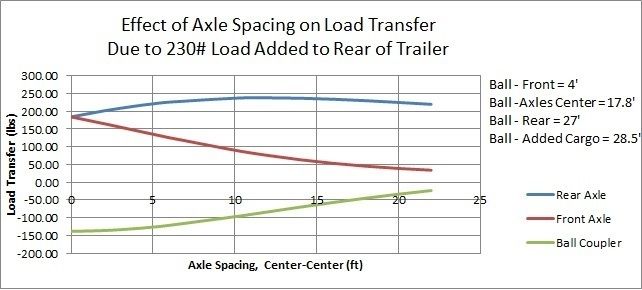
The graph below quantifies the effects of axle "spread".
TT dimensions were chosen to approximate the OP's 2014 Winnie 2201DS -- ball to front of body = 4', ball to axles' midpoint = 17.8', and ball to rear of body = 27'.
For these dimensions, the results converge to the single-axle formula provided by TundraTower which gives a load of 230*10.7/17.8 = 138# removed from ball due to 230# added at the rear.
If the axles are spaced at 5', the load removed from the ball is reduced to 126#.
As axle spacing increases, more load is added to the TT's rear axle, less load is added to the front axle, and less load is removed from the ball.
The results on the graph assume WD is not in use. Effect of WD is yet to be quantified.
The results also assume the load/deflection relationship is equal at the ball, the front axle, and the rear axle. Results of these "spring coefficient" effects will be posted as soon as I decide how to present them.
Ron
About Travel Trailer Group
44,060 PostsLatest Activity: Jul 17, 2025


