Forum Discussion


Ron_Gratz
Oct 28, 2015Explorer
mosseater wrote:Yes, spring compression does come into play. This post will attempt to answer the "how much"?
There seems to be a law of diminishing returns, though, because at some point, more weight doesn't equal proportional reductions of tongue weight. Not sure if spring compression comes into play or what. It will help, just a question of how much.
There are three sources of springiness to be considered:
1) the upward displacement of the ball as load is decreased,
2) the downward displacement of the TT's front axle as load is increased, and
3) the downward displacement of the TT's rear axle as load is increased.
These three load-displacement relationships will have to be estimated because there is little or no data available to quantify them.
The load-displacement relationship at the ball (let's call this "K1") mostly is determined by the stiffness of the TV's rear suspension.
Some owners of 1/2 ton trucks have reported a TW of around 1000# causes the ball to drop about 4" when no WD is applied.
Based on this information, let's assume a value of K1 = 1000/4 = 250#/inch.
Based on information provided by Dexter axle, their Torflex axles with 2300-4000# capacity drop about 4" when fully loaded.
If this is typical for other axles, let's assume the stiffness for these axles is 4000/4 = 1000#/inch.
Let's call the front axle stiffness, "K2", and call the rear axle stiffness, "K3", and assume K2=K3.
The effect of suspension stiffness on load removed from the ball actually is dependent on the ratios of K1/K2 and K1/K3.
Using the values proposed above, we have K1/K2 = K1/K3 = 250/1000 = 0.25.
For these assumptions, each TT axle is four times as "stiff" as the springiness at the ball.
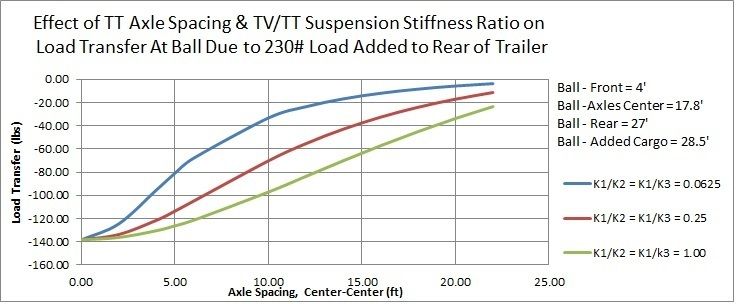
The graph below shows the effect of suspension stiffness for K1/K2 = K1/K3 ratios of 0.0625, 0.25, and 1.0. This range should cover the suspension stiffness ratios for virtually all TV/TT combinations.
For dual axle TTs, if the TV's rear suspension stiffness decreases relative to the TT axles' stiffness, the amount of load removed from the ball will decrease.
For this example and a TT axle spread of 5', if the stiffness ratio decreases from 1.000 to 0.0625 (a factor of 16), the load removal decreases from 126# to 81#.
In short, reducing the TV's vertical stiffness at the ball by 1600% relative to the TT axle stiffness caused a 36% reduction in amount of load removed from the ball.
Ron
About Travel Trailer Group
44,060 PostsLatest Activity: Jul 17, 2025


