Forum Discussion


58 Replies
 work2muchExplorer
2oldman wrote:
work2much wrote:
No. 5th wheel.
.. truck camper?
Cool. Plenty of room on 5th wheel. 2oldmanExplorer II
work2much wrote:
No. 5th wheel.
.. truck camper?- work2muchExplorer
2oldman wrote:
work2much wrote:
A very realistic fear. I ran my 48v 100ah Lifepo pack down to 10% running my air before its internal auto-shutoff was enabled at 42v. My transfer switch is human-powered and subject to error.:) Good thing these expensive batteries have all sorts of safeguards.
The more realistic fear for me is over discharging by accident.
No harm done, but scared me silly!
Are you running this in a truck camper? If so I would love to see your set-up and how you manage space. What kind of solar panels/watts were you able to install? - work2muchExplorer
2oldman wrote:
work2much wrote:
A very realistic fear. I ran my 48v 100ah Lifepo pack down to 10% running my air before its internal auto-shutoff was enabled at 42v. My transfer switch is human-powered and subject to error.:) Good thing these expensive batteries have all sorts of safeguards.
The more realistic fear for me is over discharging by accident.
No harm done, but scared me silly!
No kidding. I was thinking about adding some sort of voltage monitor the could trip a relay and control a remote battery switch if voltage got to low. This would be the redundancy added to the Victron battery protect. I have heard people say these can fail in the open circuit position.
Fortunately 10% remaining is not the same with LFP as led acid. Your bank should be fine. - 2oldmanExplorer II
work2much wrote:
A very realistic fear. I ran my 48v 100ah Lifepo pack down to 10% running my air before its internal auto-shutoff was enabled at 42v. My transfer switch is human-powered and subject to error.:) Good thing these expensive batteries have all sorts of safeguards.
The more realistic fear for me is over discharging by accident.
No harm done, but scared me silly! - work2muchExplorer
HMS Beagle wrote:
LFP are becoming more common in sailboat applications and I have read about the need to restrain them against swelling, and some opinions that it needs to be fairly stiff. But I have yet to see a spec or any tests showing how forceful this swelling can be. I have seen pictures of batteries ruined by unrestrained swelling. You could perhaps add a steel angle or square tube across your plywood end to stiffen it up - but I have no idea if that is necessary.
From what I can gather reading online these newer CALB cells don't swell unless they are pushed well over max charging voltage. One article I read they couldn't get swelling even overcharging to 4.2v
Not running a BMS to individually manage cells and shunt our redirect voltages I am going to be charging to lower limits. After bottom balancing I will be carefully monitoring where each cell rises to and adjust the charging limits for the bank to keep those fastest risers well within their designed voltage. With LFP there is so little gained by trying to push to the very top of cells capacity on both ends and so much to lose. Staying clear of the cliffs is important.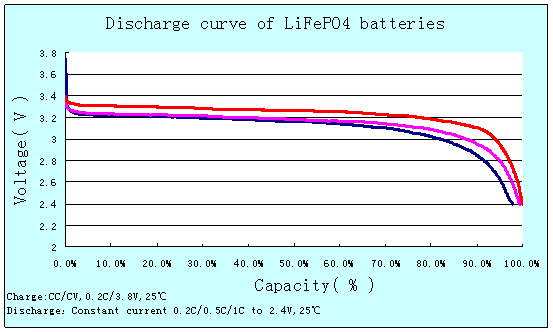
Still researching battery monitoring and management systems... My main concern isn't overcharging (and swelling) as I have decent control over that with my charging devices. The more realistic fear for me is over discharging by accident. That is what the Victron Battery Protect is for. Still looking at secondary protection options as well. centerline wrote:
No I don't buy that. Thousands and thousands of home solar systems have no such provision. Safety cut-off switch is turned for service. No one is going up on a home and cover the panels first.
properly, the panels should be covered, THEN disconnected with a switch or by being unplugged... or wait until nightfall to disconnect them... there is NO HARM to them setting in full sun and disconnected, but its the switching on or off that can cause damage. HMS_BeagleExplorerLFP are becoming more common in sailboat applications and I have read about the need to restrain them against swelling, and some opinions that it needs to be fairly stiff. But I have yet to see a spec or any tests showing how forceful this swelling can be. I have seen pictures of batteries ruined by unrestrained swelling. You could perhaps add a steel angle or square tube across your plywood end to stiffen it up - but I have no idea if that is necessary.
- work2muchExplorer
HMS Beagle wrote:
That looks like a pretty neat install. Are the end plates plywood? Does Calb specify how stiff/robust the end plates need to be?
Yes 5 ply hardwood. The bottom of the ply will be secured by angle at the base as well as the threaded rod. I have found very little info researching cell clamping requirements aside from opinions that claim cell swelling is minimal with these CALB cells. At peak charging/discharging rates I will be interested to measure cell terminal temps to see if location within the bank (as well as voltage) varies.
I have also read that prismatic cells should be restrained. I have decided to bind them with low pressure as general good practice to keep them together going down the road.
I have not read anything from CALB describing a binding process aside that one should be used. Since my redneck application is not engineered I doubt CALB could help much with (or I could measure accurately) a system of measured restraint. - HMS_BeagleExplorerThat looks like a pretty neat install. Are the end plates plywood? Does Calb specify how stiff/robust the end plates need to be?

About Travel Trailer Group
44,066 PostsLatest Activity: Oct 04, 2013


