Forum Discussion


Jfet
Jul 01, 2013Explorer
We have not been happy with the selection of 12V RV led lighting (or those in the marine selection). The home improvement environment however has a nice selection of relatively inexpensive led fixtures. Recently at Lowes we decided to hack a AC ceiling unit made by Sylvania. This is a 900 lumen surface mount light that draws 13 watts and is equivalent to a 75 watt halogen (or this is what the box says at least).
I knew these units really run on DC but I didn't know how many elements they had connected in series inside the bulb. I figured it would be around 9 to 12 which would put it well above the 12VDC available in a truck camper electrical system. After taking off the cover of the small AC to DC module mounted with 2 screws to the back of the light housing, I first measured the voltage going to the led string from the power module. This turned out to be 42VDC. This means the 9 to 12 led elements in series was a good guess. Note that it could actually be constructed of two paralleled series strings of leds. Even though externally there are only two wires, paralleling long series strings of leds is somewhat ok in practice as they tend to self balance a little bit. Paralleling just two leds without current limiting devices would eventually leave you with one or zero working leds. :-)
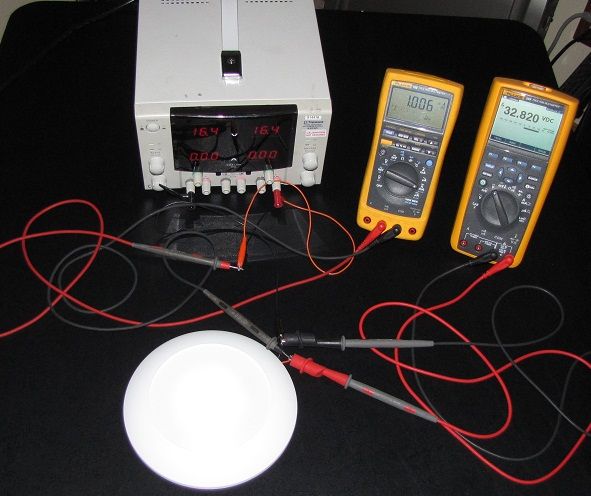
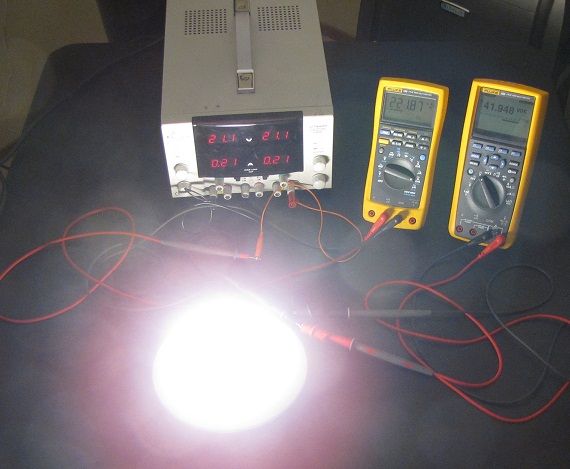
Anyway. I took some measurements at a few levels of current and found that the light just barely comes on, drawing 1mA at 32.8VDC. At 40VDC and 150mA (6 watts input) it was as bright as any interior rv or boat led light I have ever seen. At the rated 42VDC and 221mA draw, it was a small sun (call NIF and tell them we can now use those lasers for something else).
Note that I am seeing 221mA at 42VDC which would only be 9.3 watts of power input to the LED elements. Either Sylvania used a not very efficient AC to DC converter (9.3/13 = 71.5%), the 13 watt usage rating has some fudge factor in it, or the leds will have a slightly higher drop as they heat up, causing the power consumption to go up a bit. This last is probably likely and I will do a longer test eventually to confirm that.
Ok, so now we need a way to provide a constant current in the range of 150mA to 220mA with a voltage allowance of at least 42VDC, all from our 12V battery system. At first I thought building my own from scratch as there are plenty of reference designs from the IC manufacturers. A little more searching though and I have come across what might be just the ticket. This is a little module made by LEDdynamics called the LuxDrive A011 FlexBlock. It takes an input voltage of 10 to 32VDC (12V RV battery, check!) and provides an adjustable constant current output capable of driving a series string of LEDS with a total drop of up to 48VDC (needed at least 42VDC, check!) The price isn't too bad at $18 since you are getting an adjustable current source which will allow you to set the brightness and power consumption of your fixture. The Sylvania LED fixture itself was $36 at Lowes.
One other thing I like about this particular fixture is the base and bezel are all one piece of metal, providing a decent heat sink for the LEDS. With the FlexBlock boost converter operating at 90% efficiency and setting the current to 150mA, you would only have a couple watts of heat dissipated over a fairly large surface area of metal...should last forever.
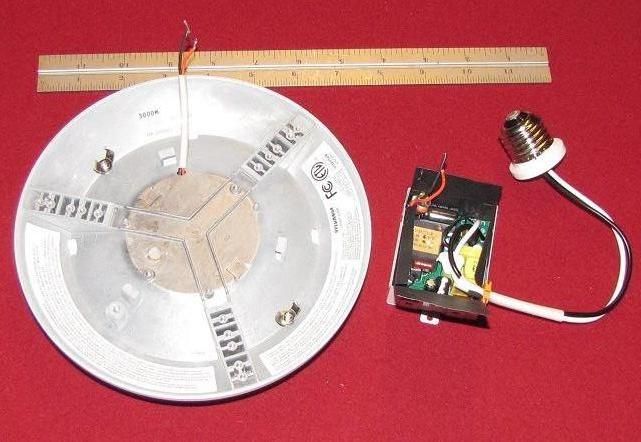
Here are some pics of the back of the unit and a shot of it running at 1mA and 220mA:
I knew these units really run on DC but I didn't know how many elements they had connected in series inside the bulb. I figured it would be around 9 to 12 which would put it well above the 12VDC available in a truck camper electrical system. After taking off the cover of the small AC to DC module mounted with 2 screws to the back of the light housing, I first measured the voltage going to the led string from the power module. This turned out to be 42VDC. This means the 9 to 12 led elements in series was a good guess. Note that it could actually be constructed of two paralleled series strings of leds. Even though externally there are only two wires, paralleling long series strings of leds is somewhat ok in practice as they tend to self balance a little bit. Paralleling just two leds without current limiting devices would eventually leave you with one or zero working leds. :-)
Anyway. I took some measurements at a few levels of current and found that the light just barely comes on, drawing 1mA at 32.8VDC. At 40VDC and 150mA (6 watts input) it was as bright as any interior rv or boat led light I have ever seen. At the rated 42VDC and 221mA draw, it was a small sun (call NIF and tell them we can now use those lasers for something else).
Note that I am seeing 221mA at 42VDC which would only be 9.3 watts of power input to the LED elements. Either Sylvania used a not very efficient AC to DC converter (9.3/13 = 71.5%), the 13 watt usage rating has some fudge factor in it, or the leds will have a slightly higher drop as they heat up, causing the power consumption to go up a bit. This last is probably likely and I will do a longer test eventually to confirm that.
Ok, so now we need a way to provide a constant current in the range of 150mA to 220mA with a voltage allowance of at least 42VDC, all from our 12V battery system. At first I thought building my own from scratch as there are plenty of reference designs from the IC manufacturers. A little more searching though and I have come across what might be just the ticket. This is a little module made by LEDdynamics called the LuxDrive A011 FlexBlock. It takes an input voltage of 10 to 32VDC (12V RV battery, check!) and provides an adjustable constant current output capable of driving a series string of LEDS with a total drop of up to 48VDC (needed at least 42VDC, check!) The price isn't too bad at $18 since you are getting an adjustable current source which will allow you to set the brightness and power consumption of your fixture. The Sylvania LED fixture itself was $36 at Lowes.
One other thing I like about this particular fixture is the base and bezel are all one piece of metal, providing a decent heat sink for the LEDS. With the FlexBlock boost converter operating at 90% efficiency and setting the current to 150mA, you would only have a couple watts of heat dissipated over a fairly large surface area of metal...should last forever.
Here are some pics of the back of the unit and a shot of it running at 1mA and 220mA:
About Truck Camper Group
300 PostsLatest Activity: Aug 22, 2026



