mrekim wrote:
JBarca wrote:
1. The ability to gain more clearance in the DC area so the WD bar does not interfere with the DC arm during compound angle turn.
2. The ability to lower the hitch head on the 6" A frame with the ball coupler on top to help avoid a crash of the trunnion bar lug into the frame during hard angle turn.
I suspect no 2 is going to not get you since you are back on the standard height ball. Since you are on the new 1 piece head, it may help but may not cure. Point: check it out.
We double checked #2 and were able to clear everything on flat ground:
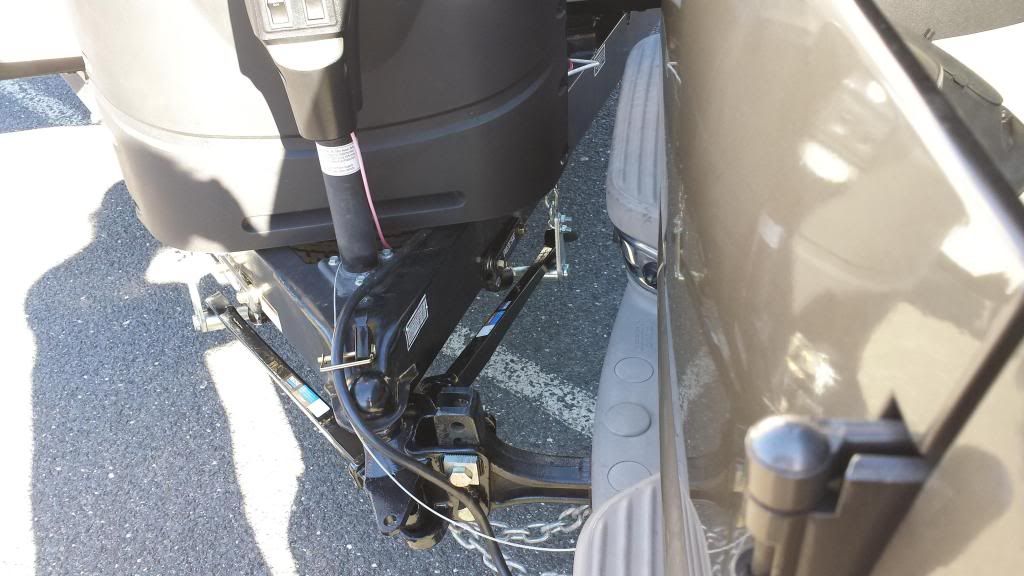
But the frame clearance was a little tight:
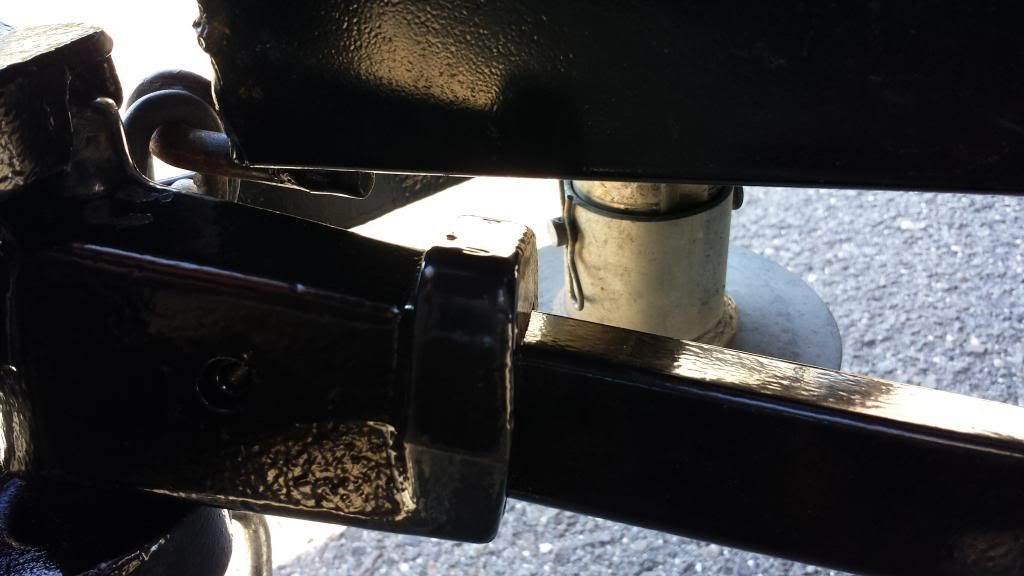
I did forget to think about and attempt to test for compound angle issues though. I was excited to be able to flip the hitch shank back over and get back some ground clearance.
snip..
Yes, you have a point with the trunnion hitting the frame on a compound angle.
If you are concerned about the shank hitting the ground, don't be with the standard shank. See this 6" drop shank on my K2500 Burb. I had 6" ground clearance and I only bounced it twice in 25K miles on that setup. Both times it was my fault as I hit a pot hole in my drive way hard and bounced the back of the truck. Your Ex I think is even a little higher than my Burb. And yes, the compound angle turn is the one to watch out for. It does not take many degrees of the truck on different ground than the TT to have the problem show up. The compound angle issue is what gets most folks. Only tow to dead level CG's...LOL
This is a 5" A frame camper


mrekim wrote:
I can try this. From my last photo with the 1" ball I was nose down 1" with that setting and 2" high with the shank flipped up. So, it seems like I should be able to simply go UP one hole with the 1" ball and be within 1/4" of level. It's beyond me why I didn't try that yesterday....
Hey, don't beat yourself up, it happens... Some times stepping back the light tuns on
mrekim wrote:
Yes, it's an Excursion 1,200 max tongue weight. Any Excursion specific advice is welcomed.
Search the forums here they have many documented up grades to help the soft sprung rear axle and roll of the truck. A Helwig sway bar on the rear axle if you do not have one and the Roadmaster RAS system. I "think" this is their master site. They changed it from the last time I visited it but it appears to be the same. Must of updated the site.
http://www.activesuspension.com/mrekim wrote:
JBarca wrote:
Your camper is empty I "think" right now, is this correct?
It has some stuff in it, most of what we would bring on a trip sans food and clothes, 49 Gal of water, and a couple of gallons in the grey/black tanks. I did pack some tools and chairs as well as the spare hitch head and trunnion bars and it added about 50 lbs to the tongue weight.
While your doing great! When you fully load the camper and the EX, you will be resetting WD over again.
mrekim wrote:
Yes, I think we're going to be near the limit on axle ratings. We limited the trailer to under 10,000 GVWR in order to not overload the Excursion.
If I use the WD to get the front suspension back to "unloaded" weight then the tongue weight is really going to be distributed between the TT rear axle and the TT axles right? The WD is just ensuring that TV weight is not transferred to the rear axle.
Odds are high you will be up against rear axle/receiver issue on loaded TW before you reach 10,000# loaded camper. Floor plan and where you can put gear drives the TW. I may have missed it, what year/model is the camper? I can look up the floor plan and see if I can tell any loading attributes in relation to TW. We happen to be a rear living layout folks and once that floor plan is loaded, they can be very tongue heavy.
To your comments on the WD hitch and the tongue weight, you used a set of words that might be interpreted incorrectly. We are really not moving tongue weight. The WD hitch helps transfer some of the heavy loads born by the rear axle imposed by the leverage of the rear overhang of the truck. Rear overhang being distance from center of rear axle to center of ball creates a real good lever. Yours might be in the 65" range. When you adjust WD, you transfer "some" of the weight off the rear axle to the front axle and the TT axles. How much moves where is dependent on wheel base, rear over hang, TT tow ball to the TT axle distance and WD bar tension. The rear axle is still bearing a high percentage of the TT tongue weight. The tongue weight is still there. Just when WD is adjusted properly the rear axle does not have to bear all the TW plus the added mechanical advantage force of the rear overhang lever effect. There is a sticky on top of the towing forum by Ron Gratz to help show the moments effect going on when WD is adjusted. Does that help clear this up some? When you adjust WD the force down on the tow ball goes up really high. A WD hitch does not change TW.
mrekim wrote:
JBarca wrote:
When you are nose high by a lot, and I consider 1" plus a lot, in some TT's this can cause instability in towing by the way the air current hit the top of the camper. When you are in the slight nose down position the air hits the of the camper different not causing negative handling characteristics.
Would this instability be some kind of up/down motion?
It "depends" on how the wind hits the camper. The effect is not always the same as the center of gravity of the TT and the mass/stability of the TV can overcome or help aggravate the issue. Not every TV and TT will have a problem towing nose high, however when the right conditions show up, it might rear it's ugly head. Light truck, soft suspension, heavy camper and TT nose high is not a good combo. The instability is more left to right than up and down axially with the center of the TV and TT from what I know. Up and down axial motion can occur from lack of enough WD and what we call proposing. (bobbing up and down going forward)
mrekim wrote:
JBarca wrote:
In summary, my thoughts for all conditions are, go back to the 1" hi rise ball, 6 links under load, stick with the new cast head and shim, tilt the head as needed for WD, 1st load the camper and the truck like you are going camping. Then adjust the WD, (with the DC in place) to return the front end of the TV very close to unhitched weight/height. When done, get the correct drop shank to level out the camper for towing. While you can only be accurate within 1 shank hole, choosing between being 1/2" high to 1/2" low, pick low. Being 3/4" high to 1/4" low, pick low. Being 1/4" high to 3/4" low pick hi.
Interestingly enough, the new cast head did not require a shim. It was the old 3 piece head that did. I'll go back to the 1" ball and set it up at the highest setting with this shank in the "lower mode" and see where I end up. I'm a little gun shy on measuring the frame on the front and rear of trailer since I got such varied measurements with the same setup. I'll try a different lot next time too...
A good question is what should be used as "level"??? I have found on several campers and longer is sometimes worse, the main frame is rigid over the axles, bows down from the axles to the front header and then the A frame can be uphill or down hill. And the frame behind the axles may bow down. I have found going inside the camper with a 2 foot or longer carpenters level on the floor just ahead of the axles is a good happy medium place to declare camper level. If you want to get real nervous, pull a string tight along the main frame rail and see for yourself. A new unloaded camper is normally better than a full loaded one.
mrekim wrote:
JBarca wrote:
Being 1 1/4" plus or greater lower starts raising the concerns front TT axle bearing more weight than it should be for the long haul.
This is interesting. Is this the case no matter what kind of axles you have? I would have figured that axles that have the equalizer between them would not suffer from that problem?
Also, if the axles are of the split type, would the problem be worse because the axle are further apart?
Torsion axles may have it worse than leaf springs but leaf springs have it too. Unless you have measured it, all 4 wheel locations have different weights. I know mine do as I was weighing each wheel independent to sort out a tire failure issue. The camper is not built dead equal left to right and after you fully load it, it will be different than it was built. The equalizer helps as the running gear goes over bumps however if you are nose high or nose low the weight is still there, again how much depends on the CG of the TT. See this Dexter application manual, bottom center for a down load. It has some good trailer design facts
http://www.dexteraxle.com/resource_library_I want to applaud you in your quest to understand your hitch system, TV and TT trying to make it as safe of a setup for towing as you can. You are learning more right now then many. And yes, it will take some time but when you are done you will understand what each adjustment does and why and reap the benefits of pleasurable towing. Folks who have rigs that just fall together nicely do not learn as much as those of us who have to work at it...
Keep at it, your doing great! Once you get the hitch done then comes understanding the TV and towing characteristics. 3 areas have to come together to create an enjoyable and stable tow rig. The TT balanced correctly as step 1, the WD hitch with anti sway controls and the TV itself. They all need to be optimized and do their part. This is especially true when using high friction type sway controls on a large camper.
Good luck and hope this helps
John



