mrekim wrote:
JBarca wrote:
Odds are high you will be up against rear axle/receiver issue on loaded TW before you reach 10,000# loaded camper. Floor plan and where you can put gear drives the TW. I may have missed it, what year/model is the camper? I can look up the floor plan and see if I can tell any loading attributes in relation to TW. We happen to be a rear living layout folks and once that floor plan is loaded, they can be very tongue heavy.
Here's the floorplan:

Axles are split design and under the dinette/Kitchen. Fresh water drain is under pantry.
Nice layout! I have seen this before, the Keystone Bullet has one similar. Tracking yours down I believe it is this one.
http://www.coachmenrv.com/products/freedomexpress.aspx?page=floorplandetails&floorplanid=4884I see you are rear living area camper folks too! Yes, we like that set up as well. See ours here:
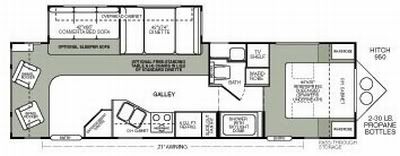
What I was looking for on yours was the declared dry TW and dry GVW. This helps establish a base line of how the camper is built and the axle location in relation to the floor plan. If that online spec sheet is correct it has a 766# dry TW with a 6,876# dry GVW 766/6876= 11.4% dry TW. You will need to load it ti get it higher. Coachman has caught up that this floor plan loads tongue heavy, and it has 2-slides rear of the axles. But it has a dresser slide forward of the axles. Your TW will rise as you load the camper. The galley is over the axles, which is good. The bath and front bedroom with pass thru cargo hole is where a lot of the storage is and will drive the loaded TW. You have some storage in the rear cabinets and that will unload TW. The good news is the fresh tank appears by your comments to be close to the axles, which is good as it helps make hauling fresh water closer to neutral on gaining or loosing TW when hauling fresh water.
The spread axles will benefit from a level towing camper.
A heads up, I do not know what size tires and load range you have on the TT, when you get fully loaded a good thing to do is get individual wheel weights and try and get ideally 20% extra reserve capacity in the tire. I hope that you where setup on high enough capacity tires from the get go. If you are over weight on one wheel for the tire, you will need to shift gear. Run the tires at max cold sidewall pressure all the time.
I will add this, just as a friendly head up. The camper is 35 feet long and you have the ability to reach 8,500 to 9,000# without too much effort. The loaded TW ideally is sitting up at 13%, and 15% is better for that size camper. You are doing a good job at trying to optimize the Reese DC. You will need too on a camper of this size. The EX most likely will benefit from the upgrades I pointed you too. If after optimizing it out, TT, hitch and TV, truck tires and you cannot obtain stable towing, research Hensley and Propride hitches. I have a buddy who had a 05 EX and a 34 ft Jayco and he went DC to hensley, however tires played a roll too for him.
In my case, I have 16% loaded TW on 9,950# GVW TT, 1,700# WD bars, 1-ton suspension, stiff sidewall tires and 167" wheel base truck and the Reese DC. The rig is stable. Before I upgraded to the F350, I was using my K2500 Suburban. I was also TW strapped on the Burb and at the pulling limit so I could only load the camper part way until the F350 came. 1,200# is all the Burb could hanlde and stay under the limits whiht what gear I had inside. I had a negative experience with new LTX tires on the Burb and while I got it under control with air pressure, I was on the edge. The F350 gained back the stability from stiffer suspension and longer wheelbase and a tire brand/type that I will not change as it works.
mrekim wrote:
JBarca wrote:
A good question is what should be used as "level"??? I have found on several campers and longer is sometimes worse, the main frame is rigid over the axles, bows down from the axles to the front header and then the A frame can be uphill or down hill. And the frame behind the axles may bow down. I have found going inside the camper with a 2 foot or longer carpenters level on the floor just ahead of the axles is a good happy medium place to declare camper level. If you want to get real nervous, pull a string tight along the main frame rail and see for yourself. A new unloaded camper is normally better than a full loaded one.
I was assuming level should be "parallel to the ground". When I did my last measurement, which nose up at least 5/8" and more than 1" on most measurement attempts, I did this exercise:
Place 2' level on ground under TT in front of axles. Use coins at end of level to adjust until level. I needed a quarter and a nickel on the TV end of the level. So the ground appeared to slope down toward TV. Then I put the level on the lip of the I-Beam frame and found I needed the same quarter and nickel under the TV end to get level.
Might this approach be better than trying to measure from the frame to the ground - and "better" than just level on the floor?
I guess I'm confused about parallel to the ground vs absolutely level.
Yes, parallel to the ground is what is meant. Level is only a point of reference to a level road. Your frame since the camper is new and not yet totally loaded should be a good point of reference. That is unless you get 2 or 3 different readings of significance now when you check it in 3 different places along the frame. Once you load it fully and the frame starts to flex, the floor inside ahead of the axles may offer a better spot. By adding your shims to the level on the ground and then the frame or floor is acceptable. You are using the level as a tool to declare parallel. Alternatively, put the edge of a piece of masking tape or sharpie mark the tape on the level tube as a reference point marker in relation to the bubble verses the shims. Both are creating "parallel to the ground".
Good luck and happy camping in your new camper. Nice layout.
John



