mrekim wrote:
JBarca wrote:
It is a fact that making a turn with a conventional WD hitch where the truck and trailer wheels are on different surface angles changes the hitch head tilt in relation to the trailer A frame. If the trailer wheels are on level ground and the truck on a surface that on angle (say 5 or 10 degrees for example) in relation to the TT, the hitch shank in the back of the truck is going to follow the truck and the hitch head with the tow ball in the coupler will pivot the WD bars. The hitch head movement will change the loading on the inside and outside turn WD bar. How much it will change will depend on the angle and the head tilt of the hitch.
Let's see if I have this right. If the truck and trailer are in line and the truck is pointing down the it will reduce the tension on the WD bars and if it's pointing up it it will add to it. Does that seem right?
I'm not picturing how tuning changes things from side to side though.
Yes, you are correct, if the truck front tires are heading down hill and the back of the truck and the TT are still on flat inline ground, the WD bars will unload for a moment in time.
And if the front truck tires are going up hill and the rear tires and TT tires are on flat inline ground, the WD bars load up more from the flex in the hitch. We nick name this "back flex" in the hitch. The bars load up, lift the TT and TV rear until they come to equilibrium. Nick name that "truck lift". Since the truck is rolling, this all happens very fast but the WD forces all changed very quick too.
The turn:
If the TV and TT are on the same hard surface inline (same plane) road and a turn begins, the loads in the WD bars are closer to equal through the turn. That is as long as you do not have extreme hitch head tilt angle. There is some WD bar load change from the trunnion lug angles.
Now throw in the truck rear tires being on an road surface which is on an angle to the TT wheels. And turn the truck at the same time. I'll call this a compound angle turn. The hitch head stuck in the truck receiver is going to rotate with the truck. The hitch head is held to the TT by the tow ball. In this process the head rotates on the ball in relation to the A frame and can change the angle of rear tilt on the WD bars.
See here. This is a mock up to show the point. The outside turn side of the hitch head goes down hill adds more head tilt to the WD bar increasing the load. The inside turn side of the head goes up hill removing head tilt which the WD bar decreases the load on the WD bar. In the case the truck is also heading down hill in relation to the camper

Now lets follow it on the truck and camper hitched up. A view from the front in a 50 deg turn on unlevel ground and not by much.
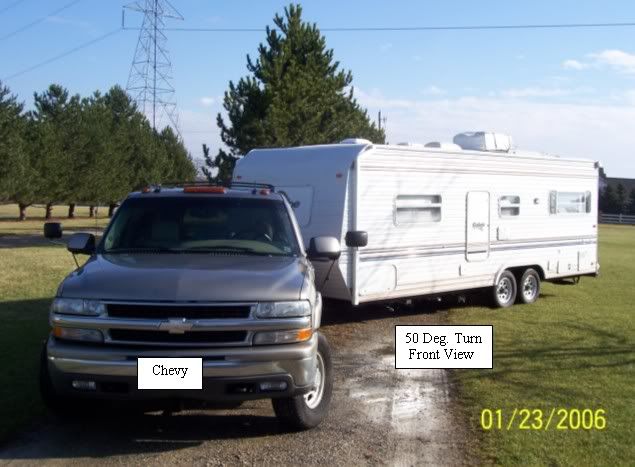
A top view
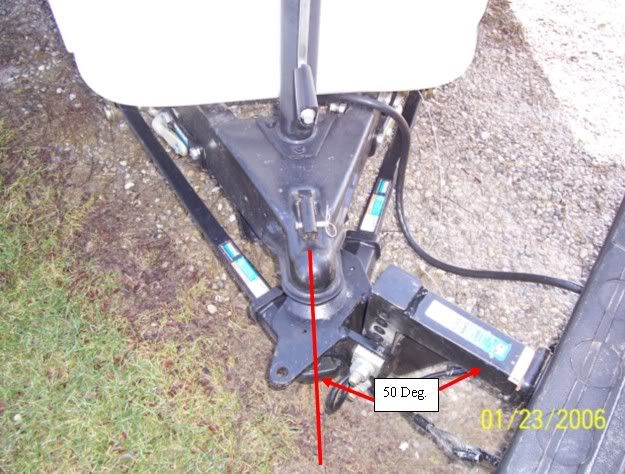
And the side view. The hitch head ball platform on top is tilted 5 to 8 degree in relation to the TT A frame. That is enough with the angle of the trunnion lugs in the head to unload the inside turn WD bar and the outside WD bar holds all the load plus ride up the cam.
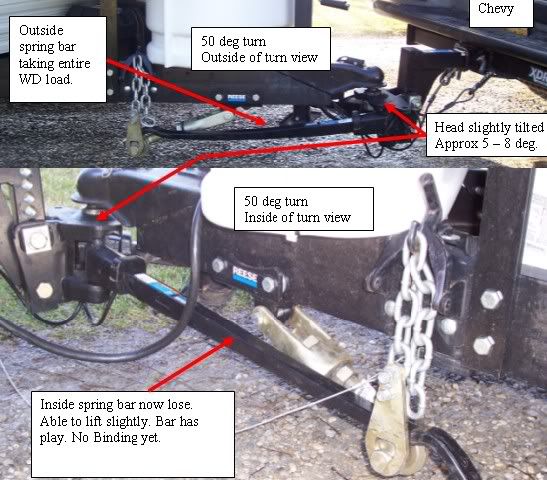
I may of added some confusion about inside turn and outside turn before but is all depends if the truck is going up hill in the turn or down hill in the turn if it is the inside or outside WD bar that unloads. Truck going up and right is different than truck going down and right and so on.
I'll leave you with this for now. Be back tomorrow. Got to go the sleep... You were typing as I was before...
Thanks
John



