mrekim wrote:
I'm going to have to read this more carefully tomorrow.... One immediate question though:
JBarca wrote:
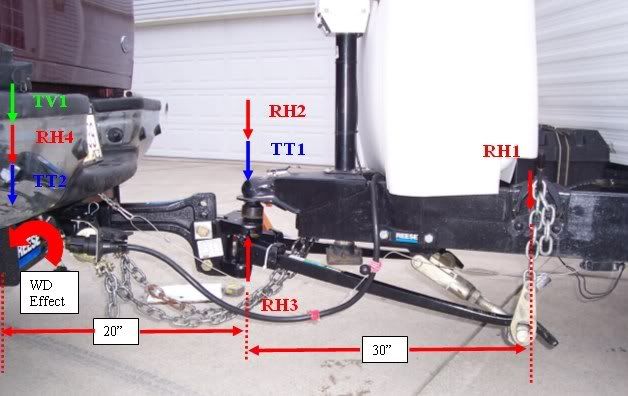
Look at the force direction arrows. The WD bar pushes down on the DC from setting up WD. The DC pull down on the chain. When in a turn there is a force that travels up the DC arm right into the front self tapping screw on the frame. There is a force then when straight ahead too, bit "i think" it is less then when in a turn like this.
For the force traveling up the DC arm when turning. I assume that is because of the curve in the spring bar. So, when turning, the the bar is trying to force the cam toward the tow vehicle and the bar prevents it from moving.
If I understand this correctly then on the inside, there would be a pulling force until the bar popped out of the curve.
Yes, you have it about right. There is a force traveling up the DC arm and that force changes constantly in magnitude depending on the terrain your are driving over. It is normal and just happens all the time. The forces and changes in force going on in a WD hitch are really dynamic.
On the DC, when the TT and TV are straight ahead and on the same plane ground, after WD is applied the force up the cam arm is fairly low providing the chain hang is perpendicular to the frame. And yes when you go into a turn, the heavy friction of the DC allows the force in the cam arm to increase. The heavier the chain load, the more the friction and the larger the force is in the cam arm resisting it. The direction of the cam arm force will be tension or compression depending on left to right side of the A frame and which direction the truck is as the WD bar pushes or pulls over the cam.
This force traveling up the cam arm is one of the reasons Reese wants us to make sure the DC frame plate is dead tight up against the bottom of the frame. And why I suggest using a C clamp like you did to hold it tight to the bottom of the frame while drilling on the DC. If there is an air space under the DC frame plate, now that force is working on the bracket itself and yanking on the infamous self taping screws, fatiguing it back and forth all day long towing down the road. Sooner or later those self tappers will rip out.
Later I will work on calculating the forces going into chain, the DC and the cam arm. They will only be hand calc's and it will be an approximation however it should help shed some light on the "league" of forces we have going on and how they change.
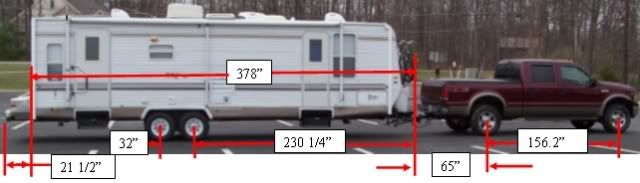
At this point I will do it for my camper and truck as I have the values needed to start with. I will vary the TW from 1,200 to 1,600# and we can see the differences. Your EX and camper will not be exactly the same unless you can tell me this data. However yours will not be totally different.
Truck wheel base
Truck rear overhand, rear axle to tow ball
Tow ball to TT axle distance
TT axle distance on the tandems
How you adjusted the WD on the truck. In my case I will use, returned the front end very close to unhitched weight
Loaded TW
WD bar size
I know the WD bar length.
This is my setup, your EX has a shorter WB but the rear overhang should be close. Your camper is a little longer and the wheels may be positioned different, however my rig and yours are not that far off other than the fully loaded TW
Be back later
John



