Bruce H wrote:
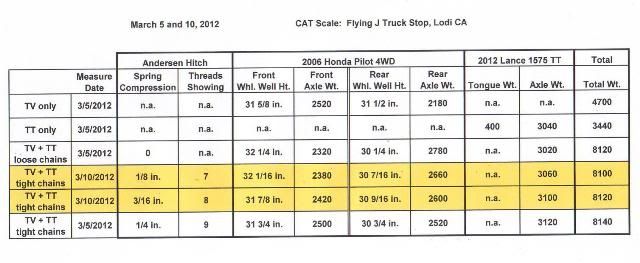
Hi Bruce,
Just made it back from camping and it seems you have been busy. Super data! :C
You are on the right track, best of luck to you. You are now starting to understand how WD works. Good for you.
For us techy types, your data is the 1st we have actually seen on how this hitch works with WD. We now have some folks out there using the hitch and are responding back which is really good.
If I added up the users right we have 2 ORF members using 2500 suspension towing , 1 using a F150 and you on your Honda Pilot. That is a range...
It would be interesting to see the scale data with spring compression like you have listed on a 800#, 1,000# or 1,200# tongue weight as a comparison.
You used 1/4" of compression on a 400# TW. Small rear overhang, short WB and short ball to TT axle distance. According to this sales video it was listed 1/4" is about 2,000# (see at the 3:22 time mark)
http://www.youtube.com/watch?v=xvM7mCnqmwo&feature=relatedThere is no reference to what TV, TW or trailer that 1/4" = 2000# lines up with. If you where using 1/4" and now on 3/16 to 1/8", really curious on what the higher TW's would use.
I have used urethane springs as punch strippers in the past. Very common and Andersen even states this.
http://www.polyprod.com/closed-end-punch-inch.htmlJust I have not used these like a compression spring as being used here. The durometer, free length and size changes the force. On the bottom of this page are some force graphs of these common in the industry.
http://www.polyprod.com/inch-tube-springs.html We do not know which spring Andersen is using other then 1/4" compression is about 2,000#.
Hopefully one of our members with a heavier TW can make it to the scales and report back.
This same hitch has a max rating of 1,400# tongue weight and there does not seem to be a change in ordering for any size less then this. At this point we can see it goes down to a 400# TW.
Thanks for sharing and good luck on your trip.
John





