jrnymn7 wrote:
pianotuna wrote:
Hi,
There would be nothing to recover. Also recharging needs a higher voltage as temperature drops, so the converter won't do as good a job. I have camped at -37 c (-34 f).
Have a look at this chart:
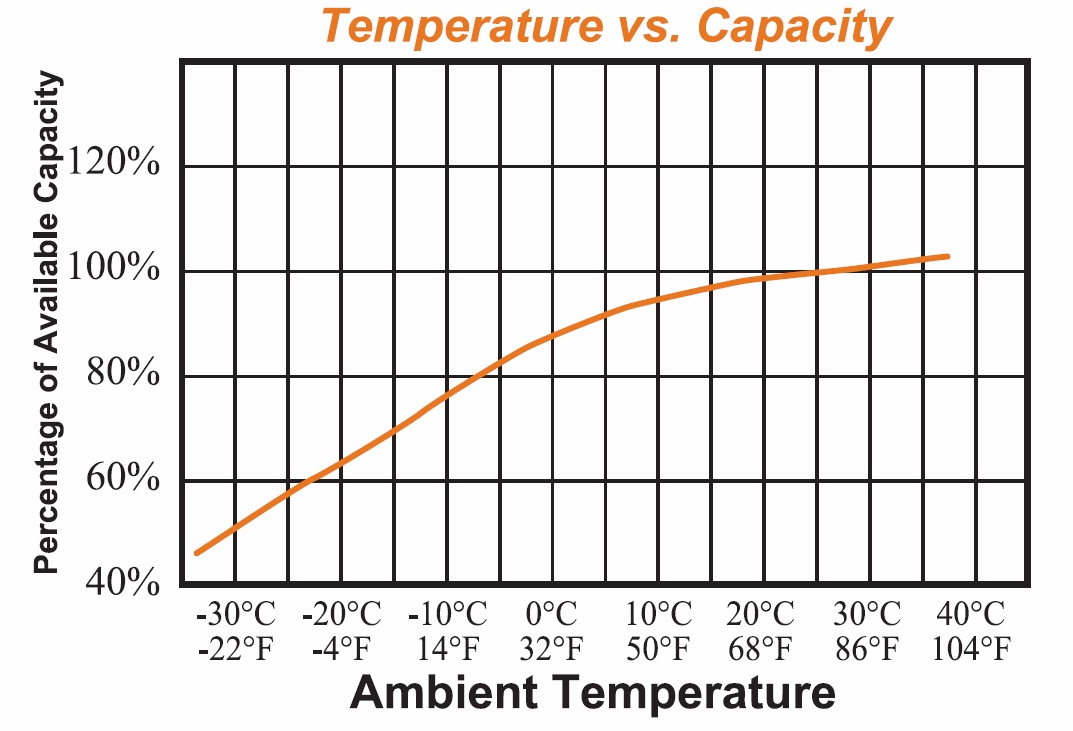
At just over the freezing mark, batt capacity is 90%.
??? How would one use this info in real world application? For example, you have a 200Ah bank, so 100Ah usable. 90% is 90Ah usable; simple enough. But should you just think of this as 10% is gone, right off the top, so max 90% soc, no matter how much you charge, and then calculate Ah usage like usual, or should you (rather?/also?) allow for 90% efficiency of the (remaining) Ah's? (In other words, should one now consider a 10a load as an 11.1a load?) thanks!
Your capacity at "full" is reduced but the voltages and SG vs SOC remain the same. Just think of it as a smaller bank. If you use your Trimetric that way, you can enter a revised capacity for the temperatures in effect.
Just using the AH counter, if 50% of your 430AH bank was when at minus 215AH, and now your bank is 400, then now you would be at 50% when the AH counter is minus 200. (You have to set the full amount when the batts are really full--right after an equalization or top charge. You can't reset it while camping because the batts never get full.)
There is some confusion again over the issue of ambient vs internal battery temperature for using the above sort of chart. When you recharge, the internal temps go up so they will have higher capacity as they warm up. Then when you stop the high amp recharge they get cold again but warm up a little for low amp draws while camping and brief high amp inverter draws.
So I suppose they can accept more AH in while being recharged at high amps, but then not be able to deliver all that back on discharge. So the Trimetric will get off kilter on AH count vs SOC. All you can do is use the AH count as a rough guide. Only really believe the "morning voltage" (near as you can get to " resting" while camping taken in between furnace on times) to tell you it is time to recharge at 12.1v (wet 6s)
Charging voltages change with temperature compensation, going up when temps go down. Here is my graph of a recharge on four 6s with my adjustable voltage PowerMax 100amper when it was just above freezing.
I chose 15.2 as being equivalent to 14.8
The two voltage curves are charger on top and battery below with the diff being drop along the wires at those amps plus some calibration diffs using different meters




