Forum Discussion

45 Replies
 pianotunaNomad III.
- SalvoExplorerYour 24V panels are not "true" 24V panels. A true 24V panel has 2 * 36 cells. You have less. That means the cliff where current drops is more to the left, at a lower voltage. Add the effect of temperature and your 24V pwm controller will have problems at higher temperature.
BFL13 wrote:
Since PWM uses Isc, which does not go down with temperature, you don't care about panel temp with PWM, but it hurts MPPT big time. - SalvoExplorerNo, I'm not talking about 10% reduction in power. I'm talking about close to 100% reduction.
We've been over this already.
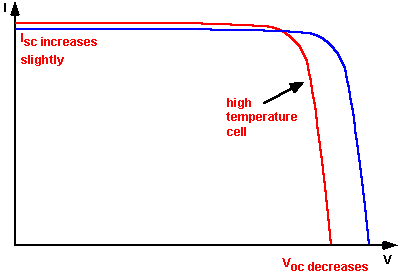
This chart doesn't have a voltage scale. Let's say the point where the two curves cross is at 14.5V. The panel outputs 10A in pwm mode. The cable voltage drop is 0.3V. When the battery gets up to 14.2V, current starts to back off from 10A and falls off the cliff. The bigger the cable, the greater the battery voltage gets before current falls off the cliff.
That's just an example with made up numbers. Get the PV voltage temperature coefficient spec for real quantities.  BFL13Explorer IIPT, I don't know what you and Salvo are on about, but for instance, my 255w panel mounted out on the grass away from the trailer on a tilted up contraption with lots of breeze off the ocean, was 50C with 25c ambient, where I measured using an IR gun gizmo pointing up underneath a foot away from the white backing. At 30+C I saw 55C panel underneath.
BTW the panel temp varies where you aim the gun. Sort of varies side to side and up to down. I couldn't solve that by swapping the panel end to end either. Might be an E-W thing, don't know. Anyway, that means each cell is at a different temp so its voltage will be different and the panel voltage is the result of all that added up.
Since PWM uses Isc, which does not go down with temperature, you don't care about panel temp with PWM, but it hurts MPPT big time. There you use input watts and output watts divided by batt V to get charging amps. That means a higher panel temp lowers panel V and so input watts and so charging amps in turn.- pianotunaNomad III.
- BFL13Explorer IIYou always need to read more than one book on any subject. It doesn't even work out to read three and believe that last one when the first two disagree! :)
- SalvoExplorerNot sure what you stated is dead wrong, but it for sure is wrong.
You should know better than that! pwm controllers need "big" cables for other reasons. High panel temperatures will lower PV voltage. Combine that with a sizable cable voltage drop and voltage at the controller can lower charge current.pianotuna wrote:
His recommendation for HUGE cables with PWM controllers. Once you have cable that will carry the number of amps safely then there is no need to go larger.  TechWriterExplorer
hbski wrote:
I too find him cranky and opinionated, but he also provides some good info. He definitely has a bias for Bogart and Tristar, but admittedly says he has not tried many others and recommends what HE knows will work from experience.
Judging from his review of MideNite's Classic controller, this should be rephrased to he recommends what HE can get to work.
Handy B could not get his Classic working the way he wanted and gives some details about it on his blog.
For example, he had trouble with the controller's arc fault detection. Let me say that I have a Classic and on the advice of others, I just turned arc fault OFF. The Classic manual (page 45) recommends you do this if you're having problems like Handy B did.
About that Classic manual -- it stinks. Could not agree more with HB about this, but that's what Adobe Reader is for . . . searching for stuff instead of paging through a paper manual . . . which I think is exactly what HB did.
Anyway, I think this HB quote about the Classic (and Outback) controllers says it all: "I know there are many people who claim to love the things. Well, people who buy any expensive thing will brag about how smart they are."
Inferiority complex much?
Instead of HB's site, I recommend Jack Mayer's site -- www.jackdanmayer.com.- pianotunaNomad IIIHi Gale,
We owe you for your efforts on the spreadsheet. The least I can do is help promote it.
Doing solar without an energy audit may be unwise.
I know that on shore power I use about 20 kwh per day. That has led me to abandon going to a much bigger solar farm--so I'm back to using solar as an assist and for battery charging.  N8GSExplorer
pianotuna wrote:
Some of handy bob is dead wrong. I've included a much better less wordy and less opinionated link below.
Here is a simple flow chart.
Budget-->Energy Audit-->Battery bank size-->number of watts-->PWM or MPPT. What ever type of controller is chosen, make sure it has adjustable set points and a temperature probe that is on the battery.
If you use solar as a battery charger, one rule of thumb is between 60 and 150 watts of panels per 100 amp-hours of storage. The smaller the battery bank the higher the wattage needed (per 100 amp-hours). Here is a link to the rather special spreadsheet which includes an energy audit, that N8GS has created to help size solar battery charging systems!
solar spreadsheet by N8GS
If you full time or use an inverter lots, then populate the entire unshaded area of the roof with panels. I'm considering replacing my awning with solar panels.
For a nice explanation of solar, try this link:
Golden rules of solar
Handy Bob's info was good when written but today the available parts are much different and the solar industry has matured.
For those wondering about what size wire to use please refer to my spreadsheet it has an extensive wire calculator page that includes voltage drop and how much energy is wasted in heating the wire.
Don - I'm glad to see that you are still recommending my spreadsheet.
About Technical Issues
Having RV issues? Connect with others who have been in your shoes.24,363 PostsLatest Activity: Mar 05, 2026


