Forum Discussion

buylow12's avatar
buylow12
Explorer
Jul 28, 2015

What's eating my batteries? (Please help:()

Alright so after two months of being parked at a rv park while my wife completed her first travel nursing assignment we decided to go do some boondocking in one of the many national forests up here in Washington. We did a decent bit of boondocking on the way out here and have made a few mods to make it more comfortable(200w solar panel and propane heater) so we were ready to go after sitting around for two months.

So we get to our spot and I check our batteries just for the hell of it(We can usually go two days without any sun) and there like half way depleted. THat was quite the surprise after two months hooked up plus 3+ hours towing, they should have been FULL. So I think, maybe the converter had stopped working and since it had been cloudy the panels couldn't keep up over maybe two days. However after only a few hours with nothing more than basically a light on, the batteries are now real low. So just used the cutoff switch and turned the 12v completely off. The next day it was still cloudy but after a few hours appeared the panels had made some juice. So I then cut the 12v on, we made some lunch, and then went for a hike. When I get back the batteries are flat although nothing was on. Today I'm back at a campground with hookups and my converter seems to be working 100%.

SO my question is, what is eating my batteries? I thought maybe the converter was bad, maybe something is drawing a heavy phantom load, or some how my batteries are bad(they are only 3 months old). I seem to have already ruled out the first one but I'm not even sure how to test the other two. We've camped before with no battery issues what so ever and the only thing I can think of that we've changed on the 12v is adding a powered TV Antenna but that's off and I can't see that taking that much power anyways. I do have a digital multimeter. So how can I check the other two? Is there something else that I'm not thinking of?

I'm going to be flying home LATE tomorrow and am putting the fifth wheel in storage for two weeks tomorrow afternoon so I'd really like to get this handled. I was counting on the solar panels and batteries to run my propane fridge while we are gone. If I can't figure something out I was thinking of pulling all the fuses but the fridge and the propane leak detector and hoping that it'll hold out. Any advice appreciated on that account too.

Thanks for the help,

Tim Czarkowski
TotalTravelers.com

29 Replies

  • With 200W of module and a decent MPPT controller, you may not need the converter at all. In storage, the solar will keep everything charged. To make sure you are getting some charge from the solar, wait until you have good sun and measure voltage across the battery terminals. You should be seeing a charge voltage > 13V.
    Also, some controllers don't like the battery power being disconnected before removing panel input power. If you don't have a switch or fuse between the module and the controller, throw a blanket over it before disconnecting the battery connections.

    When using shore power with the converter operating, check the electrolyte level at comfortable intervals.

    BTW, get those battery terminals and connections cleaned up......yesterday ;). I use two cans of spray when servicing batteries. One is an acid neutralizer with soap that changes color in the presence of acid. The other is a can of terminal sealer. Baking soda and grease are alternatives. To save a terminal from oxidizing like your negative terminal, put a penny underneath the battery clamp.

    Battery University---good education.
  • i would change the solar controller setting to Flooded batteries
    sealed AKA VRL batteries like AGM's can take higher charging and float voltages

    flooded batteries PARKED and hooked up
    you want a 13.2v float voltage

    turn the converter OFF during the day, let the solar do the maintaining , run the converter at only at night
    might be better until you can revamp the system
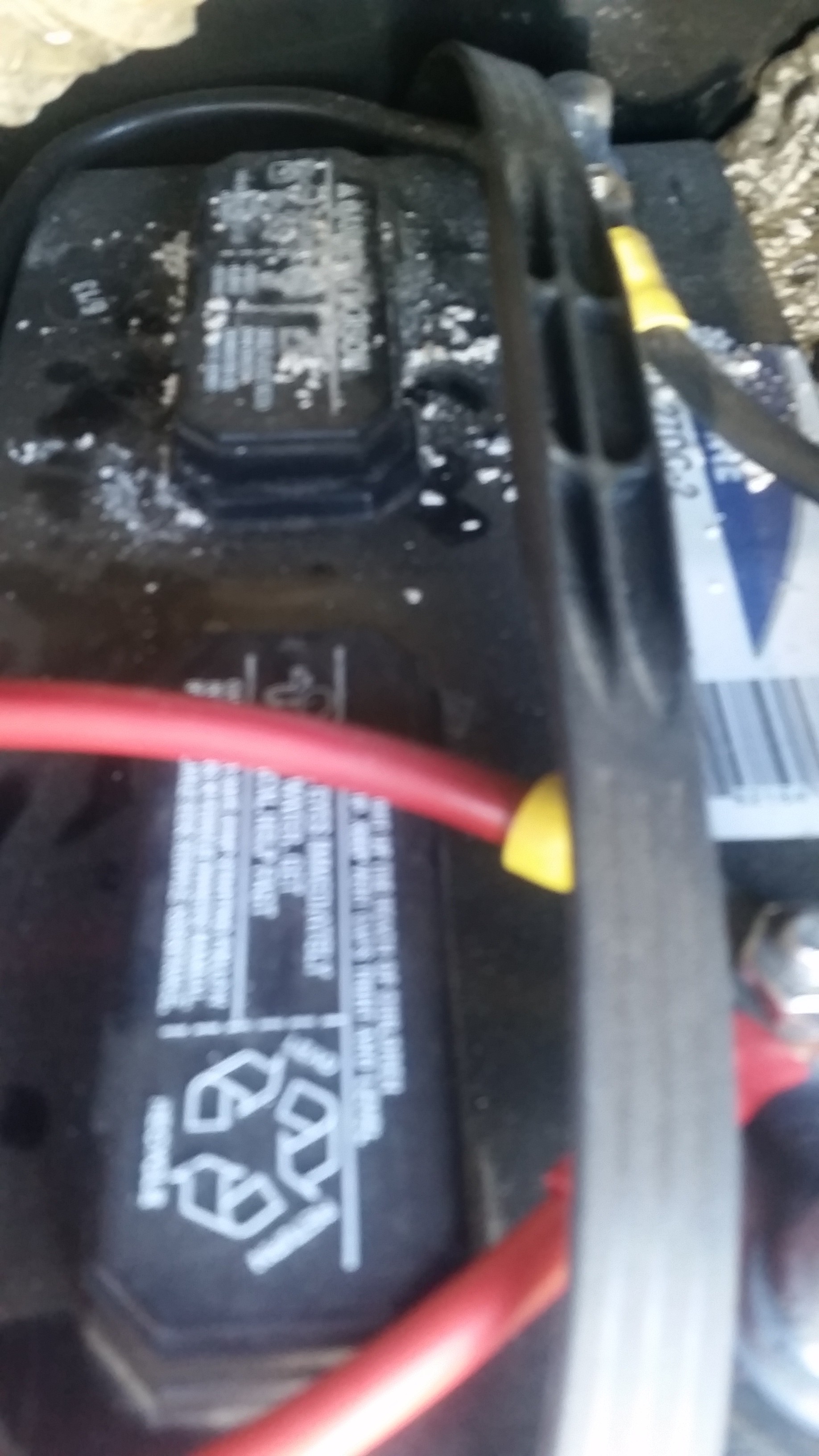
  • Ok I pulled them out and the one seems to have plenty of water, it's about halfway up the inch deep openings. The other one however has a little bit in two of the three openings on the positive side and I can't see it in the third. The positive side is worse, I can't see any liquid in any of the three. However if I rock it a bit I can hear a liquid down there. There are pictures down below.

    So I am going to buy some distilled water and fill it back up. Are these not sealed batteries then? Since these batteries are only three months old, assuming one is bad and one is good, could I just buy one new one if I can find an identical one? My charger does seem in fact seem to be one that just runs at 13.6v all the time, if I can't change converters right away, would I just be able to keep refilling the batteries as necessary and they wouldn't be damaged from that? If so how often should I check them to be safe? My solar charger is an MPPT and is set for sealed lead acid, I assume it would be smart enough not to boil off my batteries?

    Sorry for the barrage of questions, I just want to figure out what went wrong, and even more importantly, how to keep it from happening again.

    You all have been extremely helpful.

    Tim Czarkowski
    TotalTravelers.com


  • We’ve had two 100 watt solar panels and a MPPT controller added to allow us to boondock for more than a day or two. I bought a remote monitor for the panels also so we can easily track what state the batteries are in and how much juice the panels are putting out.


    Tim what voltage settings did you use on the solar controller

    with Flooded Cells, about 14.4v is good when dry camped
    but for being parked with hook ups for months 13.8v (or maybe less) is a better choice
  • Tim - I have to agree that your batteries were probably over-charged by your converter and boiled the electrolyte/water off. You'll need a flat headed screw driver to pop off the tops of the batteries and see what has happened.

    There are different types of converters installed in various RVs. Some have smart chargers which throttle back on the charging voltage when the batteries are fully charged. But many of them just keep cranking the voltage, and eventually, the electrolyte evaporates.

    If it were me, I'd do the following:

    1. Check the electrolyte level. If low, refill with distilled water.
    2. Try charging them back up to see if they'll take a charge. If they are too far gone, they probably won't.
    3. If they won't take a charge, take them to an auto parts store for them to check them for you.
    4. Replace the batteries with new ones.
    5. Replace the converter with a new smart charging version.

    It will cost you quite a bit of $$, but in the end, you'll be able to charge the batteries and boondock with confidence.

    Jim
  • Those batteries have caps for checking electrolyte level and adding water
    Those are not sealed batteries, they are most likely ruined
  • I was told these are sealed lead acid batteries(which means they don't need water added right?)One came with the RV and I was told it was new and then bought an exact match to make a pair. They are Autocraft marine deep cycle 27dc2. I posted a picture below. If that was the case am I to assume they are shot? How can I tell or test them. A picture is below. My converter is 45 amp model and my solar controller is a MPPT, should they avoid boiling it off? Shouldn't it still have been charged anyways after being towed? Sorry I'm quite new to all of this,(and I always seem to learn the hard way, lol). I sure hope that's not the case since I just bought these like three months ago. Although I would be relieved to know what it is fix it, and then hopefully not do that again, lol. I did pick the cheapest batteries I could find just for that reason.

    I'll give that a shot my multimeter does have a dc10A setting. I have Trailer Life's "Rv Repair and Maintenance Manual" and the electrical section had nothing like this I was quite disappointed in it a a reference. I suppose I need to get the electrical specific one also. We live on it fulltime time so we're always on it or do you mean like when we were gone hiking?

    Thanks for the advice,

    Tim Czarkowski
    TotalTravelers.com

    I do see some white power over the negative terminal on one of the batteries. I assume that's not a good sign :(

  • If your multimeter has the 10A option, great. Undo the positive main terminal from the batteries, insert the multimeter between the positive post and positive wire. It will give you a reading. Now go to your 12V fuse panel, pull one fuse at a time until the reading goes to zero. Likely culprits are LP/CO detector, AM/FM radio, propane fridge if it's on. I always disconnect my positive wire from my batteries when not at the trailer, the solar panel remains connected to charge the batteries.
  • Have you checked the water level? Plugged in two months and you may have boiled the electrolyte out and the plates are compromised.

About Technical Issues

Having RV issues? Connect with others who have been in your shoes.24,363 PostsLatest Activity: Mar 04, 2026