Forum Discussion


Griff_in_Fairba
Nov 08, 2017Explorer III
As far as I can tell, Mother Mopar uses the same starter relay in all makes (Chrysler, Plymouth, Dodge, DeSoto, and Fargo) and all models (compact to luxury sedan to pickup trucks and motorhomes) over lengthy spans of years. The result is extensive availability, in stock in most parts stores, and a limited number of alternatives covering all possibilities. (Model year seems to be the primary -- or only -- factor in which is right for you.)
Before continuing, there's a lot of conflicting and contradictory information on Dodge starter relays on the 'net so be careful. Some is iffy and some is downright scary or perplexing. Likewise, Google has a problem keeping Dodge, Ford, GMC, and so forth separate and distinct. (For example, googling "1979 Dodge starter relay" will bring up links for Ford starter relays -- it's a search algorithm issue.)
Model year 1973 and earlier used a four terminal relay, apparently without any variations. SMP part number SR-103.
Model year 1977 and later used a five terminal relay, with several minor variations. SMP part number SR-111.
Model years 1974 through 1976 were a transition period, with either of the two possible. Both part numbers possible.
Standard Motor Products (SMP) part numbers are representative, covering most applications in this thread. The two part numbers above are a starting point and you may need to work with your parts counter person to get an exact match to what you need.
Model year 1973 and earlier:


Note the 'fusible link' in the second picture. Whenever I encounter one of these, I try to determine the link's ampere rating and replace it with a Maxi fuse or suitable circuit breaker. (In this case, there's valid arguments for and against self-resetting circuit breakers ... it depends on how well you pay attention to what's going on in your vehicle.)
Model year 1977 and later:


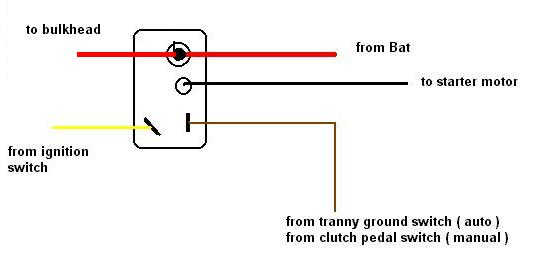
The first and second images (pictures) show one variation in the form of two blade connections on the center terminal. The third image (illustration) shows an acceptable alternate, in the for of a single blade connection on the center terminal.
Double blade connections on a terminal allows more wires to be connected to that terminal. (As a general rule, you should never place more than four wires on a single terminal connection.)
Another variation, not shown here, is a single or double blade connection instead of the threaded stud. Throughout the decades, the threaded stud was used as a 'common junction' for various parts of the engine's circuits. (e.g., battery and alternator circuit source) I believe replacing the threaded stud with blade connectors occurred in later years, with the 'common junction' moved elsewhere. (This is beyond the scope of my experience so I can't say definitely ... I've only seen it in internet pictures and am too lazy to dig deeper.)
VERY IMPORTANT NOTE: Unlike voltage regulators and ICMs, Dodge starter relays do not get their negative/ground connection through the case or mounting screw. Instead, there's a dedicated negative/ground terminal for ground-side switching. In our motorhomes, this is connected to the automatic transmission's Neutral Safety Switch, which only provides a ground connection when the transmission is in park or neutral.
Note: The neutral safety switch on our automatic transmissions often a combined unit with three terminal prongs. One prong is for the starter relay ground and the other two are a supply-side switch for the back-up lights when the transmission is in reverse gear. (Neutral Safety Switch is a throwback to the early 60s when the switch had a single terminal and purpose ... the term has been retained even though the unit now combines two switches with distinctly different purposes.)
Consider the possibility a previous owner or mechanic may have converted your motorhome from one type of starter relay to the other. (Forethought and logic rarely deters people from doing the inexplicable.)
Likewise, I've seen a few cases where someone has replaced the OEM starter relay with a larger Ford-type starter relay. I imagine they had to put a lot of time and effort into that. To do it successfully requires a significant degree of knowledge.
Enough, TTFN.
Before continuing, there's a lot of conflicting and contradictory information on Dodge starter relays on the 'net so be careful. Some is iffy and some is downright scary or perplexing. Likewise, Google has a problem keeping Dodge, Ford, GMC, and so forth separate and distinct. (For example, googling "1979 Dodge starter relay" will bring up links for Ford starter relays -- it's a search algorithm issue.)
Model year 1973 and earlier used a four terminal relay, apparently without any variations. SMP part number SR-103.
Model year 1977 and later used a five terminal relay, with several minor variations. SMP part number SR-111.
Model years 1974 through 1976 were a transition period, with either of the two possible. Both part numbers possible.
Standard Motor Products (SMP) part numbers are representative, covering most applications in this thread. The two part numbers above are a starting point and you may need to work with your parts counter person to get an exact match to what you need.
Model year 1973 and earlier:
Note the 'fusible link' in the second picture. Whenever I encounter one of these, I try to determine the link's ampere rating and replace it with a Maxi fuse or suitable circuit breaker. (In this case, there's valid arguments for and against self-resetting circuit breakers ... it depends on how well you pay attention to what's going on in your vehicle.)
Model year 1977 and later:
The first and second images (pictures) show one variation in the form of two blade connections on the center terminal. The third image (illustration) shows an acceptable alternate, in the for of a single blade connection on the center terminal.
Double blade connections on a terminal allows more wires to be connected to that terminal. (As a general rule, you should never place more than four wires on a single terminal connection.)
Another variation, not shown here, is a single or double blade connection instead of the threaded stud. Throughout the decades, the threaded stud was used as a 'common junction' for various parts of the engine's circuits. (e.g., battery and alternator circuit source) I believe replacing the threaded stud with blade connectors occurred in later years, with the 'common junction' moved elsewhere. (This is beyond the scope of my experience so I can't say definitely ... I've only seen it in internet pictures and am too lazy to dig deeper.)
VERY IMPORTANT NOTE: Unlike voltage regulators and ICMs, Dodge starter relays do not get their negative/ground connection through the case or mounting screw. Instead, there's a dedicated negative/ground terminal for ground-side switching. In our motorhomes, this is connected to the automatic transmission's Neutral Safety Switch, which only provides a ground connection when the transmission is in park or neutral.
Note: The neutral safety switch on our automatic transmissions often a combined unit with three terminal prongs. One prong is for the starter relay ground and the other two are a supply-side switch for the back-up lights when the transmission is in reverse gear. (Neutral Safety Switch is a throwback to the early 60s when the switch had a single terminal and purpose ... the term has been retained even though the unit now combines two switches with distinctly different purposes.)
Consider the possibility a previous owner or mechanic may have converted your motorhome from one type of starter relay to the other. (Forethought and logic rarely deters people from doing the inexplicable.)
Likewise, I've seen a few cases where someone has replaced the OEM starter relay with a larger Ford-type starter relay. I imagine they had to put a lot of time and effort into that. To do it successfully requires a significant degree of knowledge.
Enough, TTFN.
About Motorhome Group
38,779 PostsLatest Activity: Jun 18, 2026


