SCVJeff wrote:
DiskDoctr wrote:
---snip---Your gps settings should include a zipcode setting, which will adjust for declination. Also look for your satellite info display. It will show the number and signal quality of birds you're connecting to.
In Alaska the angles to geosynchronous (think "equator") satellites are awfully close to the southern horizon.
WHAT?
- So the GPS has a place you enter your Zipcode so it can locate itself? That's rather novel. I would have thought a GPS could tell you what Zip-code you were in, not the other way around.
- What Declination? We're not setting up a polar arc antenna
- Take a look at the GPS constellation. It is Asynchronous, not geosynchronous, and arguably not even that. Either way, not one of the GPS satellites in any of the three constellations out there are Geosynchronous.
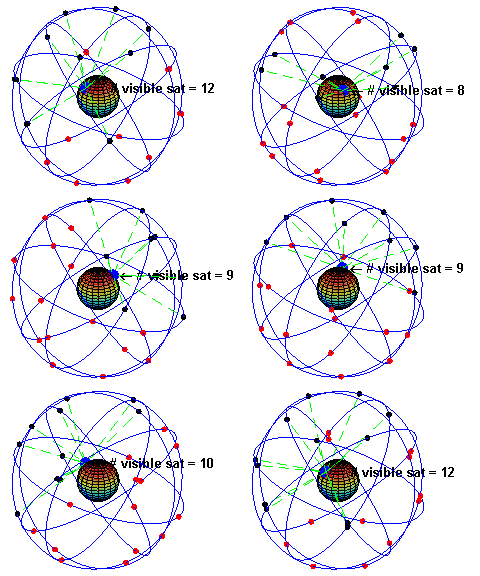
That is correct. The orbits are approximately at a 60 degree angle to the equator. So at a high enough latitudes there will never be satellites directly overhead. You still should pick up the signals from satellites lower on the horizon. At any point on the earth there may be times when no satellite is directly overhead, but just wait a 1/2 hour or so and one will move your way. You need a minimum of three satellites to get any position lock at all, and with only three there will be a large error factor. (Some GPS units will not display a position with only three. Designed that way on the idea that no position displayed is better than a grossly erroneous position). Four is considered the minimum for any practical use. The more the better. This is why sometimes in deep narrow canyons with dense tree cover you lose signals -- the signals are blocked by mountains and trees, with only one or two satellites 'visible' to your unit.
Because the satellites are orbiting all over the earth except at the poles, places on Canada and Alaska will have all the satellites visible to you in the south half of the sky, whereas most every else the visible satellites will be scattered all around you, more or less evenly distributed across the sky. When the signals are all coming from the same part of the sky there will be a larger error factor.
When you first turn on the unit, it can take several minutes to display a position. The satellites also transmit what is called an 'almanac' containing all the settings, satellite positions, correction factors, etc. Your unit needs this information before it can calculate a position. This is why after being off for several days the unit will take several minutes to find you (the almanac data is old and no longer valid. It has to download fresh data again). After a turn off of only a few minutes, such as refueling, it displays position almost immediately -- the almanac data is still fresh.
Entering a zipcode is giving a jumpstart to the calculations. You are telling the unit approximately where you are instead of calculating your position from scratch.
The other post about there are only two systems, GPS and GLONASS, is right. The Europeans are also launching satellites, but are using the same frequencies and signals as the U.S. GPS system. The European satellites are just added to the U.S. system. Our government basically said to the other countries "This is getting expensive to operate and maintain. If you are going to use it then help us pay for it."



