ShinerBock wrote:
4x4ord wrote:
^^^ Thanks for posting the graph Shiner. I see the torque drops off after 2800 even faster than I had imagined and illustrated in my graph ... which makes its power output even more sensitive to rpm. I wish the manufacturers would publish things like torque curves and brake specific fuel consumption maps.
Yeah, doing the math and doing a rough overlay where the Cummins torque/hp would be over the L5P graph above, it is clear to see that the Cummins turbo is utilized for more low-end power and the L5P probably uses a larger turbo that comes on later for more top-end power. Nother wrong with either, just depends on where you want your power.
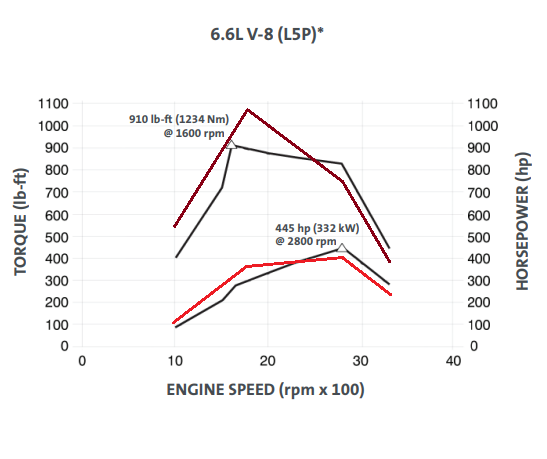
Your right there is nothing "wrong" with either, however, for towing grades the Cummins produces a much more desirable curve. When climbing a hill the incline of the hill together with the weight of the truck and trailer combination largely determine the necessary rear wheel torque. As the truck slows the required rear wheel torque only drops slightly. The truck will slow until the required rear wheel torque is met. So, the Duramax powered truck will slow more rapidly and is much more likely to require a drop in gears to meet the hill's demand. Having a close ratio transmission behind the Duramax will limit the drop in speed. As the Cummins pulls down the rear wheel torque increases at a much higher rate to meet the challenge .... a downshift is much less likely to be required.
Edit:
More than likely if consumer marketing convinces Ram to go to a ten speed transmission there will be demand on Cummins to go to a different turbo or whatever else might be needed to flatten out their torque curve .... raising the peak HP of the engine and coming up with a curve more similar to that of the Powerstroke. And there is nothing wrong with that either, but, if I had a Cummins I'd be happy with its towing characteristics and don't think I'd be crying for a Powerstroke.





