Forum Discussion

14 Replies
 CA_TravelerExplorer III
RoyB wrote:
I'm not seeing the problem. Just add 2 very small fuses for your positive shunt. And since all 4 wires to the panel are already fused...
YES - all of the shunts would be mounted as close to the source as possible.
The problem is the BOTH sides of the shunt to frame ground is at the full DC CURRENT potential if it is mounted on the POSITIVE side of the battery. If you let something grounded touch the small wires feeding the meter movement it will go up in smoke in heartbeat. I guess you should always fuse both lines going to the meter movement???
Maybe it isn't that much of a problem but using the HALL EFFECT type sensor will only have the very small meter potential present on the two meter movement leads and zero potential from either one of those two wires to frame ground.
Also I wonder about the accuracy of the cheap hall effect sensor which may be accurate enough for some applications. That is as compared to the accuracy of a shunt. RJsfishinExplorerI'll buy that.
I know, it don't matter, they don't use enuff power to even care.
I have several led meters now, and I've not switched any of them, on all the time.ctpres wrote:
No power statement is just way to describe new style meter. Older version was four wire and required different power source. New version just needs two wires and gets meter power from voltage being measured which makes for a much simpler installation. Only down side is the range of voltage it will measure is limited on the low end (stops working around 7.5 volts) but that is not problem for typical 12 RV use. If your battery gets below 8 volts it really won't matter. Enjoy. LScamperExplorerRoyB wrote:
"I DO NOT want to go with the SHUNT TYPE current taps as then I have to deal with high current 'HOT' DC wiring running back to my meter console."
Put a 2K resistor on each of the shunt meter leads at the shunt. Then run the meter to the other side of the 2K resistors. The resistors will not change the meter reading and will limit any short circuit current to a harmless value.- Peg_LegExplorerRJsfishin, I have one and it will take several weeks for may batteries to drop 1/10th of a volt. I wired mine with a on/off switch that I never turn off now.
The blue light makes for a nice night light on the stairs inside the 5er.  MrWizardModeratorI think it's common practice to mount shunt in the negative lead
It's so common, that the Turnigy power meter has the internal shunt, in the negative side of the circuit RoyBExplorer IITENBEAR - Thanks... I would have to rewire my battery bank scheme a tad to do that but is doable... I have all of my battery switching in the POSITIVE SIDE of each battery and the NEGATIVE Lead of each battery goes straight to FRAME GROUND. I would have to use a TERMINAL BLOCK arrangement to run thru a NEGATIVE TERMINAL installed shunt to a single frame ground point.
This is my current battery bank setup with my HALL EFFECT SENSOR in the POSITIVE SIDE of the selected batteries thru the switch arrangement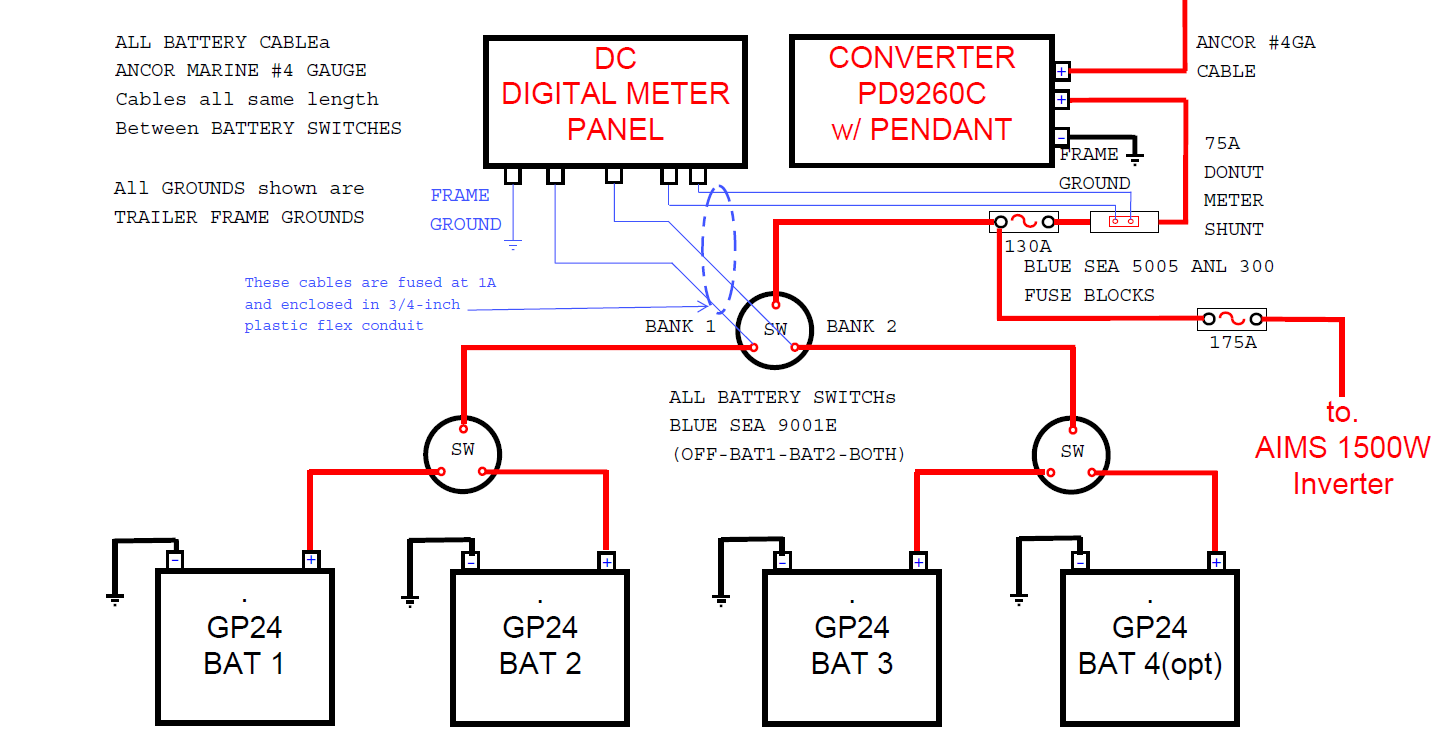
Roy Ken tenbearExplorerIf you can put the shunt in the negative lead of the battery, then the "hot" wire would only be milli volts above ground. Shorting it to ground would not be a problem. Of course, if the shunt would open up then all the current would flow thru the meter wiring. A good reason to put a fuse in the "hot" meter wire.
- RoyBExplorer IIYES - all of the shunts would be mounted as close to the source as possible.
The problem is the BOTH sides of the shunt to frame ground is at the full DC CURRENT potential if it is mounted on the POSITIVE side of the battery. If you let something grounded touch the small wires feeding the meter movement it will go up in smoke in heartbeat. I guess you should always fuse both lines going to the meter movement???
Maybe it isn't that much of a problem but using the HALL EFFECT type sensor will only have the very small meter potential present on the two meter movement leads and zero potential from either one of those two wires to frame ground.
This is where my fears are coming from...
Roy Ken - westendExplorer
tenbear wrote:
RoyB wrote:
I DO NOT want to go with the SHUNT TYPE current taps as then I have to deal with high current 'HOT' DC wiring running back to my meter console.
Is there some reason that you can't mount the shunt near the battery?
X2
The shunt-> meter wiring only carries a small, millivolt level of electricity. The meter measures the level of current being carried through the shunt by measuring small voltage differential. That differential is carried by the wire. In mine, I believe it is 24 ga. wire. - tenbearExplorer
RoyB wrote:
I DO NOT want to go with the SHUNT TYPE current taps as then I have to deal with high current 'HOT' DC wiring running back to my meter console.
Is there some reason that you can't mount the shunt near the battery?
About Technical Issues
Having RV issues? Connect with others who have been in your shoes.24,363 PostsLatest Activity: Mar 03, 2026


